Table of Contents
Why Trump’s Praise Came Wrapped in a Complaint
The “Trump: India took advantage of US” controversy that erupted after Donald Trump’s June 4 remarks is being treated as a story about rhetoric, but the real significance lies in what was happening behind the scenes. At the same event, Trump argued that the trade equation had now reversed and expressed confidence that a deal would soon be finalized.
#WATCH | President Donald Trump says, "For years, India took advantage of the United States… They charged us tremendous tariffs and paid nothing… Now it is the exact reverse and we are making a lot of money with India. But we will get to a deal because I like your Prime… pic.twitter.com/IR2x2MqUV5
— ANI (@ANI) June 4, 2026
That combination is unusual because it mixes diplomatic reassurance with public pressure. At precisely the same moment, Indian and US negotiators were wrapping up intensive talks in New Delhi led by Assistant USTR Brendan Lynch and Indian Additional Secretary Darpan Jain. Commerce Minister Piyush Goyal later confirmed that most major issues had already been settled and that the first tranche could be executed by mid-July 2026.
If the relationship is supposedly strong and the agreement nearly complete, why does Washington still feel the need to publicly raise the temperature?
Sources: The Indian Express, CNBC TV18, The Economic Times
The Hidden Story Behind the “Final 1%”
US Ambassador Sergio Gor’s statement that the trade agreement is “99% there” sounds reassuring. Yet the remaining 1% may be the most politically sensitive portion of the entire negotiation.
According to Gor, the unresolved issues largely involve legal wording and implementation timelines. On paper, that sounds technical. In reality, technical language often determines what governments are actually obligated to do once headlines fade.
The proposed framework already includes a reduction of US reciprocal tariffs on Indian goods to 18%, down from previous peak levels that reached 50%, including penalties linked to India’s continued purchases of Russian crude oil.
The critical question is whether the final legal text locks India into expectations that were politically easier to discuss in February than they are to implement today. That question becomes even more important once another development enters the picture.
Sources: ANI News
Why India’s Silence May Be Costing More Than Its Trade Concessions
India’s strongest negotiating victories may be receiving the least public attention.
In February 2026, the White House released a factsheet claiming India had “committed” to purchase more than $500 billion of US goods and would eliminate digital services taxes and tariffs on certain pulses. One day later, the White House revised the document. “Committed” became “intends.” References to agricultural products, pulses, and digital services taxes disappeared entirely.
This was not a cosmetic edit.
India is the world’s largest producer and consumer of pulses and has historically protected the sector through tariffs. The revision strongly suggests Indian negotiators resisted pressure on agriculture and digital taxation despite public expectations created by Washington.
Yet India rarely wins the communication battle. During the April 2026 controversy over Trump’s sharing of comments describing India as a “hellhole,” New Delhi’s formal response emerged only after domestic pressure intensified. A similar pattern is visible today: India appears firm at the negotiating table but often reactive in the public narrative.
For Indian readers, that creates a strategic dilemma. If Delhi continues securing substantive concessions while allowing Washington to dominate the messaging, what effect does that have on future negotiations?
Sources: The White House, NDTV
The Tariff Threat Most Headlines Are Missing
The most important development may not be Trump’s rhetoric at all.
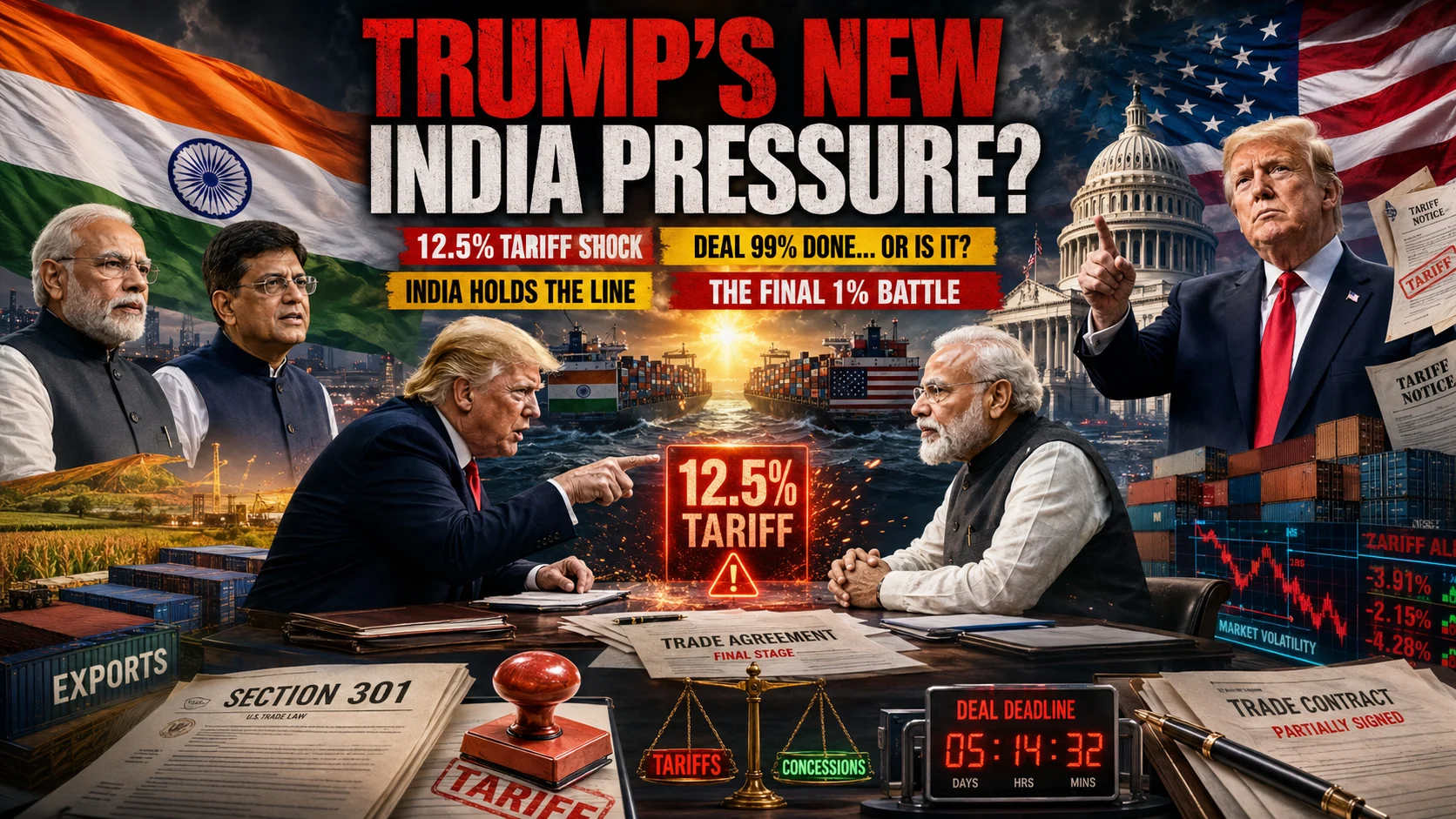
The proposed 12.5% Section 301 tariff looks less like a forced-labor policy and more like a negotiation instrument arriving exactly when the trade talks entered their final stage.
On June 2, the Office of the US Trade Representative proposed a 12.5% tariff on imports from countries including India and China under a Section 301 investigation concerning failures to enforce prohibitions on forced-labor goods. The investigation covers 60 economies representing roughly 99.4% of US imports, with comments due by July 6 and hearings beginning July 7.
The timing connects two otherwise separate facts: the trade deal is allegedly 99% complete, yet Washington simultaneously introduced a new tariff mechanism after emergency tariffs were struck down by the US Supreme Court in February 2026. The result is a plausible conclusion competitors have largely missed: the Section 301 process may be functioning as a legally durable source of negotiating leverage precisely when conventional tariff tools became vulnerable. The question is whether this leverage disappears after the deal is signed.
Sources: The Times of India
What the White House Quietly Removed Matters More Than What It Announced
Many reports focused on the original White House claims. Far fewer examined the retreat.
The revised February 11 factsheet removed references to agricultural concessions and softened the language surrounding the proposed $500 billion purchase program. That matters because agriculture remains one of the most politically sensitive sectors in India.
A casual observer might assume the revisions signaled weakness in the negotiations. The evidence points in a different direction. If Washington expected easy access to agricultural markets, those references would not have disappeared from an official document within twenty-four hours.
The broader implication is that the remaining disagreements are not about whether a deal happens. They are about who controls the interpretation of the deal after it happens. That distinction helps explain why apparently minor wording disputes have become so consequential.
But is this negotiating style unique to India?
Sources: NDTV
Is Washington Repeating a Familiar Negotiation Pattern?
The pattern visible in India-US trade talks resembles behavior seen elsewhere.
During the May–June 2026 US-Iran negotiations, Trump reportedly edited a tentative agreement multiple times, focusing on highly specific technical issues involving enriched uranium and Strait of Hormuz controls. Those edits delayed finalization despite broader progress.
The comparison is not that India and Iran are equivalent cases. The similarity lies in the method. Public optimism is paired with late-stage revisions, technical renegotiations, and pressure applied after apparent breakthroughs.
At the same time, India has reduced its vulnerability through trade diversification. The India-EU Free Trade Agreement concluded in January 2026, covering extensive tariff reductions. Meanwhile, the India-Australia ECTA now provides full duty-free access for Indian exports to Australia, helping bilateral trade reach USD 24.1 billion.
That hedge changes the balance. India is negotiating with Washington from a stronger position than it would have occupied a few years ago.
Conclusion
The obvious interpretation of Trump’s “India took advantage of the US” remark is that it reflects lingering frustration over tariffs. The more important interpretation is that the remark arrived alongside a new Section 301 tariff threat, while negotiators were supposedly resolving only technical details.
Those facts together suggest the final stage of the India-US trade agreement is not really about friendship, public praise, or even the remaining 1%. It is about leverage.
India appears to have successfully resisted pressure on agricultural tariffs and digital services provisions, while simultaneously building alternative trade pathways through the EU and Australia. Yet New Delhi continues to struggle in the domain of strategic communication, allowing Washington to define the public story even when India secures substantive outcomes.
The agreement may be close. The real test is whether India can preserve its negotiating gains while also shaping the narrative around them.
FAQ
What did Donald Trump say about India taking advantage of the US?
On June 4, 2026, Trump stated that “for years, India took advantage of the United States” through high tariffs. In the same remarks, he also expressed confidence that a trade deal would be reached because of his relationship with Prime Minister Narendra Modi.
Why is the US proposing a 12.5% tariff on Indian exports?
The USTR proposed the tariff under a Section 301 investigation concerning failures to enforce prohibitions on forced-labor goods. The proposal covers India, China, and dozens of other economies, with hearings scheduled for July 2026.
Is the India-US trade agreement really 99% complete?
US Ambassador Sergio Gor described the agreement as “99% there,” with remaining issues focused on legal wording and implementation timelines. Commerce Minister Piyush Goyal has indicated the first tranche could be executed by mid-July 2026.
Did India agree to buy $500 billion of US goods?
The original White House factsheet stated India had “committed” to purchases exceeding $500 billion. A revised version changed the wording to “intends,” reducing the strength of that claim.
Why did the White House remove references to pulses and agriculture?
The revised factsheet eliminated references to agricultural products, certain pulses, and digital services taxes. This suggests those issues remained unresolved or were not accepted in the form originally presented.
Closing Question
If Washington is already using Section 301 tariff pressure before the India-US deal is signed, what happens when future disagreements emerge over agriculture, digital taxes, or the revised $500 billion purchase intention after the agreement enters force?
Share Your Views in the Comments below.
Explore more about Economy & Trade.