Table of Contents
The Fighter Gap India Can No Longer Ignore
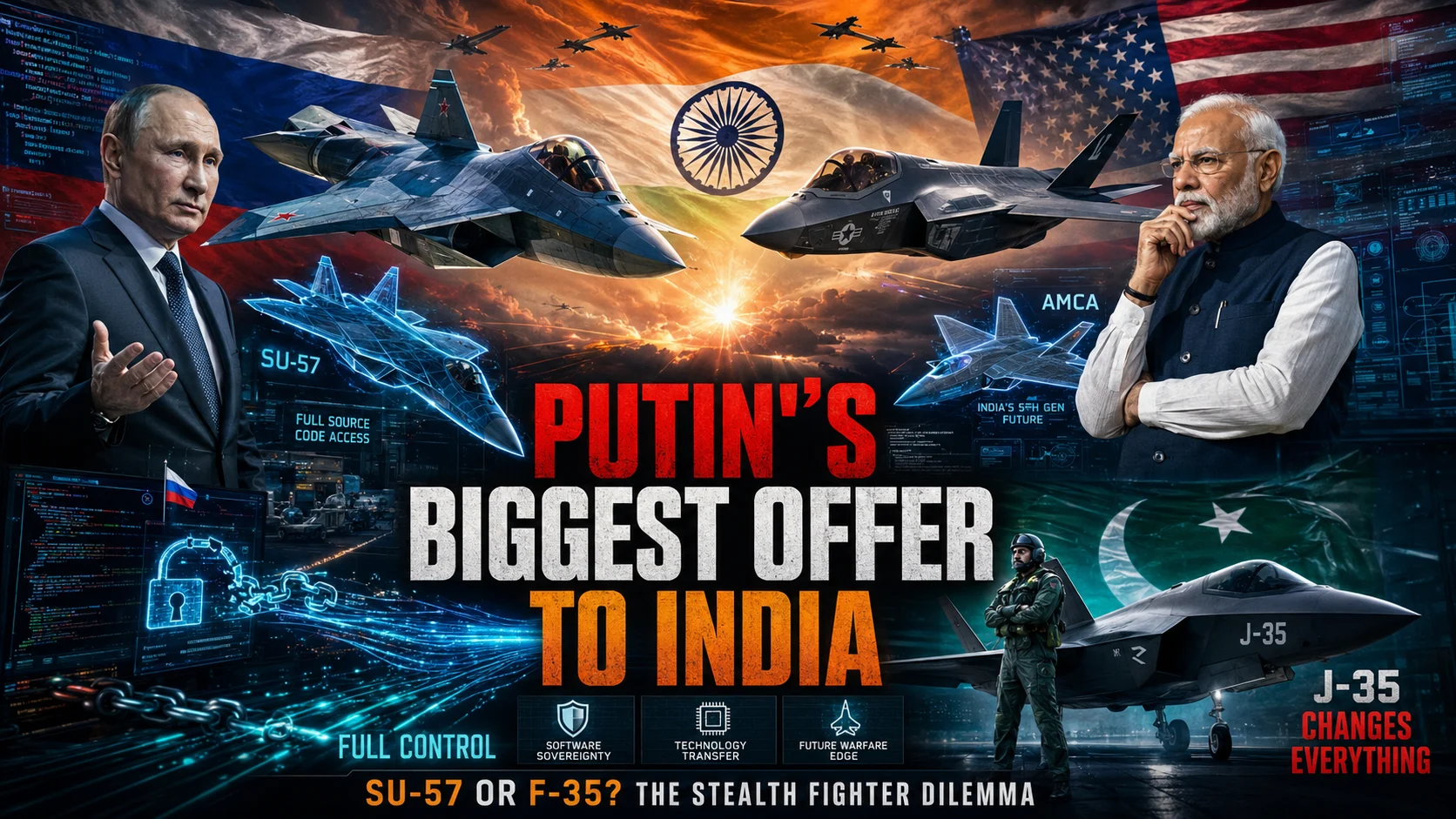
Putin Su-57 offer to India has transformed India’s fifth-generation fighter debate from a long-term modernization challenge into an immediate strategic decision.
The trigger is not China alone. Pakistan has approved the acquisition of 40 Chinese Shenyang J-35 stealth fighters, while pilot training reportedly began in China in July 2024. At the same time, the Indian Air Force operates no active stealth aircraft despite facing a two-front strategic environment.
The timing is particularly uncomfortable. The IAF currently fields only 29 active fighter squadrons against a sanctioned strength of 42, while multiple SEPECAT Jaguar squadrons approach retirement. Meanwhile, China’s J-20 fleet continues expanding and the J-35 is entering Chinese service.
India’s long-term answer remains the Advanced Medium Combat Aircraft (AMCA), but current plans place series production around 2035–2036. That leaves nearly a decade in which India’s competitors could field operational stealth fleets while the IAF continues relying primarily on 4.5-generation platforms.
The question is no longer whether India needs a fifth-generation fighter. The real question is why Russia suddenly believes India may be ready to reconsider the Su-57.
Sources: India Today
The Real Meaning Behind Putin’s New Offer
The most important part of the Putin Su-57 offer to India discussion is not the aircraft itself.
On June 4, 2026, Russian President Vladimir Putin offered India joint development and supply of the Su-57 with “no restrictions” on technology transfer. He reinforced the proposal again at the St. Petersburg International Economic Forum (SPIEF) on June 6, arguing that India makes sovereign decisions and that external sanctions threats would “boomerang immediately.”
ICYMI: Putin Offers 🇮🇳 Full Access With 'No Restrictions' To 🇷🇺's 'Best In The World' Fighter Jet
— RT_India (@RT_India_news) June 5, 2026
The Su-57 "could be a joint venture between us. We developed it ourselves, and we're certainly ready to work with India, supplying and developing it further. There are no… pic.twitter.com/5aObQfsaq2
But the strategic centerpiece of Moscow’s proposal is far more specific: full source-code access.
This matters because India’s defense doctrine increasingly revolves around strategic autonomy rather than platform ownership. A fighter aircraft is only as independent as the software controlling its radar, electronic warfare systems, sensors, and weapons integration.
Russia is not selling India a fighter first. It is selling control.
The sharpest insight behind Moscow’s pitch is that it directly exploits growing concerns over foreign software dependence. If India cannot fully customize critical mission systems on future platforms, even large acquisitions can leave operational freedom constrained.
The significance of Russia’s offer is not that the Su-57 suddenly became a better stealth aircraft than the F-35. It is that Moscow identified a vulnerability in India’s procurement philosophy. As stealth fighters become software-defined combat systems, source-code sovereignty may become more strategically valuable than marginal differences in radar visibility. If that logic is correct, India’s choice becomes far more complicated than a simple aircraft comparison—but what does that mean for India itself?
Sources: India Today
Why India’s Next Decision Matters More Than the Aircraft Itself
India’s biggest challenge is not choosing between Russia and America. It is balancing readiness, sovereignty, and time.
The Ministry of Defence approved a new Programme Execution Model for AMCA on May 27, 2026 and issued RFPs to three private-sector groups: Tata Advanced Systems; the Larsen & Toubro–Bharat Electronics–Dynamatic Technologies consortium; and the Bharat Forge–BEML–Data Patterns consortium.
The roadmap targets a prototype by 2029 using the GE F414 engine, a maiden flight within 30 months of contract signing, and production around 2035–2036.
That schedule creates a strategic dilemma. Pakistan’s J-35 timeline arrives years before AMCA enters service. The IAF’s squadron deficit already exists today. Waiting entirely for AMCA risks extending the stealth gap. Importing aircraft solves readiness but can undermine indigenous development if managed poorly.
India therefore gains from treating foreign acquisition as a bridge rather than a destination. The strongest argument for any interim fighter is not immediate combat power alone. It is whether the purchase accelerates India’s domestic aerospace ecosystem rather than delaying it.
That raises another uncomfortable question: why did India walk away from a similar Russian project in 2018?
Sources: The Economic Times
The Ghost of the 2018 FGFA Collapse
The history of the Fifth Generation Fighter Aircraft (FGFA) program explains why enthusiasm for the Su-57 remains mixed.
India formally exited the Fifth Generation Fighter Aircraft (FGFA) project with Russia in 2018 after investing roughly ₹1,483 crore. Concerns included costs, technology-transfer limitations, engine performance, and doubts regarding the aircraft’s stealth characteristics.
Those concerns did not disappear overnight.
A 2020 RAND commentary argued that the Su-57 lacked the low-observable design characteristics associated with aircraft such as the F-35. During the 2024 Zhuhai Airshow, Chinese social media users openly mocked visible manufacturing imperfections on displayed Su-57 prototypes.
Yet the environment has changed since 2018.
The aircraft is no longer an unproven prototype. Algeria became the first export operator in late 2025 under a deal estimated at roughly $2 billion for 12–14 aircraft. Russia also argues that the enhanced Su-57M1 variant addresses earlier concerns through improvements including the AL-51F-1 engine.
The result is a debate that looks very different from the one India rejected eight years ago. But does that automatically make the American alternative more attractive?
Sources: The EurAsian Times, RAND Cooperation, Wikipedia: Sukhoi Su-57, The Diplomat, Forbes
Why the F-35 Is Stronger on Paper but Harder in Reality
The F-35 remains the benchmark for all-aspect stealth and sensor integration.
That is precisely why U.S. Vice President JD Vance promoted the aircraft during his April 2025 visit to India. From a purely technical perspective, the F-35 offers capabilities that many analysts consider superior to those available on the Su-57 today.
JD Vance offers sales of F35 fighter jets for the Indian Air Force pic.twitter.com/maacHz6iDt
— Shashank Mattoo (@MattooShashank) April 22, 2025
However, procurement decisions are not made in engineering laboratories.
The American export model remains highly centralized and tightly controlled. Operational restrictions, software control, and limited technology transfer have historically been core features of the F-35 ecosystem. That approach works comfortably for treaty allies integrated into U.S.-led security architectures.
India is different.
New Delhi’s strategic culture prioritizes decision-making independence. The same doctrine that drove investments in indigenous missiles, air defenses, and aerospace programs also shapes fighter procurement. Even if the F-35 offers stronger stealth performance, political and operational constraints may prevent it from fitting India’s long-term doctrine as cleanly as its technical specifications suggest.
Yet there is another factor that may prove decisive before technology or geopolitics do.
Sources: The Times of India
The Economic Shock Nobody Is Connecting to Fighter Procurement
The overlooked variable in the Putin Su-57 offer India debate is economics.
The US-Iran conflict that began on February 28, 2026 disrupted the Strait of Hormuz and pushed Brent crude into the $95–$97 range by June. At the same time, the Indian rupee weakened sharply, crossing ₹90 per dollar in February, ₹95 in March, and ₹96 in May.
Most fighter comparisons ignore this reality.
Every large foreign procurement becomes more expensive when the currency weakens. Every imported subsystem carries higher financial pressure. Even a country that recorded 7.7 percent GDP growth in FY26 must account for exchange-rate risks and rising energy costs.
This changes the procurement conversation. The issue is no longer simply which aircraft performs best. It becomes which acquisition model places the least strain on India’s finances while strengthening domestic aerospace capabilities.
That economic lens helps explain why technology transfer, local production, and industrial participation suddenly carry as much weight as stealth performance.
Sources: Firstpost
Conclusion
The common assumption is that India’s fifth-generation fighter decision will be determined by which aircraft is better.
The evidence suggests something more complicated.
Pakistan’s incoming J-35 fleet, China’s expanding stealth inventory, the IAF’s squadron deficit, and AMCA’s long timeline have created immediate pressure for an interim solution. The F-35 remains the stronger stealth platform. The Su-57 still carries unresolved questions rooted in the FGFA experience.
Yet Moscow’s offer is strategically significant because it targets India’s deepest defense priority: autonomy.
The debate is therefore shifting away from radar cross-sections alone and toward control of software, customization, industrial participation, and long-term sovereignty. Add a weakening rupee, elevated oil prices, and pressure on defense finances, and the procurement equation becomes far broader than aviation technology.
India’s next fighter purchase may ultimately reveal less about air combat and more about how New Delhi defines strategic independence in an era of software-driven warfare.
FAQs
What is the latest status of Putin’s Su-57 offer to India?
President Vladimir Putin formally offered India joint development and supply of the Su-57 on June 4, 2026 and renewed the proposal during SPIEF on June 6, 2026. The offer includes unusually broad technology-transfer provisions and discussions around local participation.
Why did India leave the FGFA program with Russia?
India withdrew in 2018 due to concerns over costs, technology transfer, engine development, and doubts regarding the Su-57’s stealth performance. The decision came after India had already invested approximately ₹1,483 crore in the project.
Does India have a formal Countering America’s Adversaries Through Sanctions Act (CAATSA) waiver for the S-400?
No. Although the U.S. House passed an amendment supporting an India-specific waiver in 2022, a formal presidential CAATSA waiver had not been executed as of 2026.
How does Pakistan’s J-35 acquisition affect India?
Pakistan has approved the purchase of 40 J-35 stealth fighters and initiated pilot training in China. If deliveries proceed on schedule, Pakistan could field operational stealth aircraft years before India’s AMCA enters production.
Which private companies are competing for India’s AMCA program?
The shortlisted entities include Tata Advanced Systems; a consortium of Larsen & Toubro, Bharat Electronics, and Dynamatic Technologies; and a consortium of Bharat Forge, BEML, and Data Patterns.
Closing Question
If software sovereignty becomes more important than stealth superiority, will India ultimately choose the fighter that performs best in combat—or the one it can truly control?
Share Your Views in the Comments below.
Explore more about Defense & Security.