Table of Contents
Why the Rawalakot Crisis Was Never About Electricity Prices
The Rawalakot Kashmir protests June 2026 are being presented as an uprising over inflation, subsidies, and electricity bills. That explanation is incomplete.
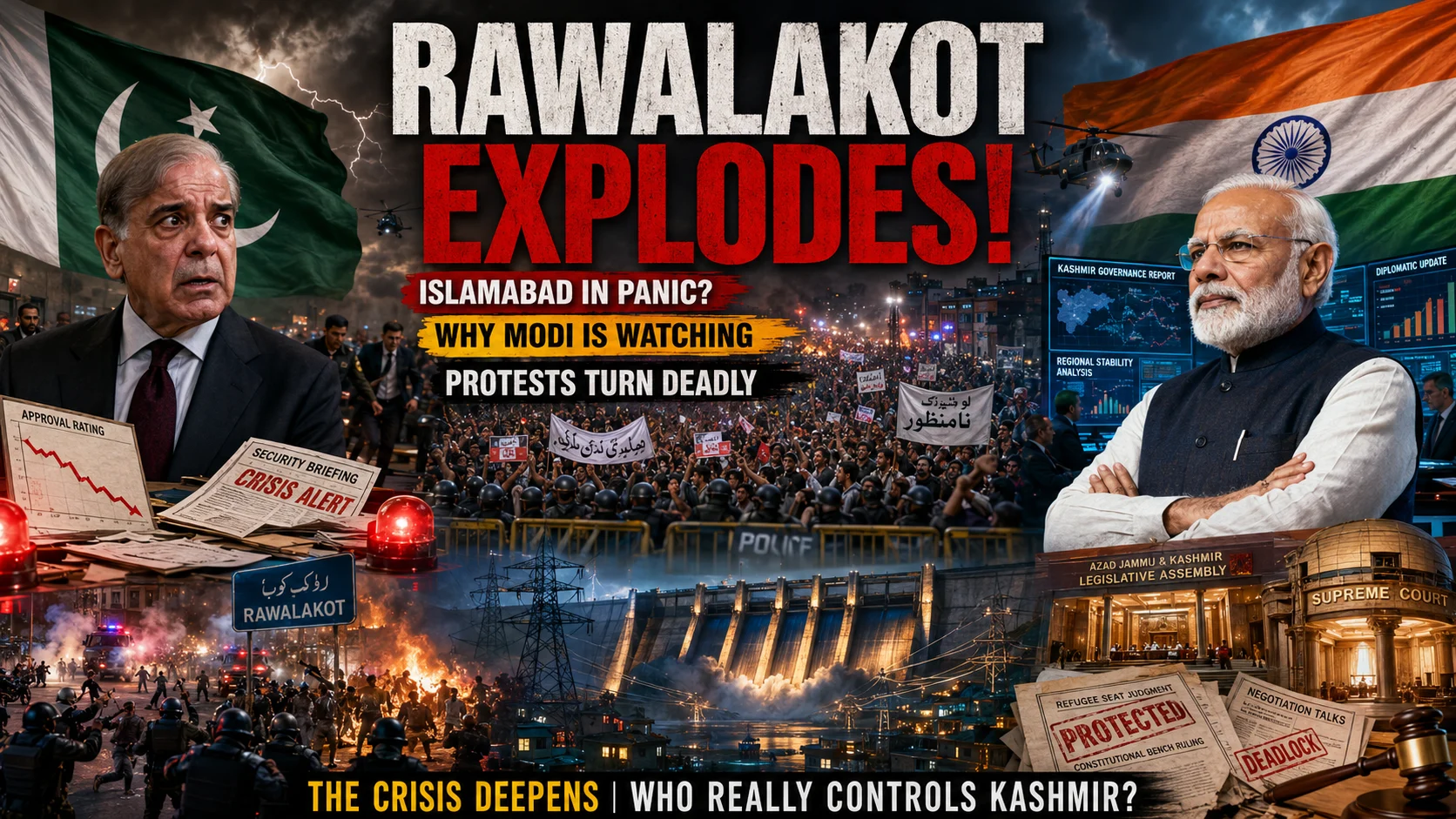
The immediate trigger came on June 5, 2026, when security forces intercepted a vehicle near Barmang Bridge close to Rawalakot. Rights leader Sardar Umar Nazir Kashmiri survived the shooting, while Shahzeb Habib, an executive member of the Joint Awami Action Committee (JAAC), was killed. His death transformed an already tense political dispute into a mass mobilization movement.
PoJK erupts with 'Hukmarano dekh lo ham tumahri maut hai ' chants 🔥🔥!
— War & Gore (@Goreunit) June 7, 2026
The people of PoJK completely rejecting the illegal Pakistani occupation….
PS: लोहा गरम है, हथौड़ा मार देना चाहिए😁 pic.twitter.com/TjvhZwRUTx
Within days, authorities formally banned the JAAC under the Anti-Terrorism Act. Violence escalated further when police reported that armed members of a banned group stormed a military hospital in Rawalakot, killing police personnel and triggering a wider confrontation. Official figures acknowledged multiple deaths and dozens of injuries among both protesters and security personnel.
Most breaking-news coverage stops here. But the real question is why a protest movement that had already negotiated with authorities suddenly became impossible to accommodate.
Sources: News18, Republic, India Today
The Court Ruling That Changed Everything
The decisive turning point was not the Barmang Bridge shooting.
It was the June 7 advisory opinion issued by the Supreme Court of POK (called Azad Jammu and Kashmir by Pakistan) , which ruled that the 12 reserved refugee seats in the AJK Legislative Assembly enjoy constitutional protection and cannot be abolished without a constitutional amendment.
That ruling struck directly at one of the most politically sensitive demands associated with the broader reform movement. Critics argue these seats allow voters living in mainland Pakistan to influence political outcomes inside the territory, creating what many see as a mechanism of political engineering.
The court’s decision effectively removed the regional government’s ability to offer meaningful constitutional concessions through executive action. Simultaneously, the JAAC was designated a terrorist organization.
This was the moment negotiations stopped being a political process and became a security operation.
Once the refugee-seat issue became constitutionally protected and the JAAC became legally proscribed, Islamabad lost its easiest path to de-escalation. The state could still negotiate tariffs and subsidies, but it could no longer negotiate the political structure that many protesters considered the deeper problem. The result was a predictable shift from bargaining to containment—but what happens when an economic movement concludes that economics was never the main issue?
Sources: Centre for Peace Studies, The Star, AP News
Why India’s Silence Was More Dangerous Than Any Statement
For India, this crisis creates strategic advantages without requiring any direct involvement.
New Delhi has consistently maintained that Pakistan occupied territories remain under illegal occupation. During the unrest, India’s Ministry of External Affairs lodged a strong protest against Pakistan’s June 7 elections in Gilgit-Baltistan and reiterated that Jammu and Kashmir, Ladakh, and Gilgit-Baltistan are integral parts of India.
At the United Nations Human Rights Council, India’s representative Anupama Singh contrasted Jammu and Kashmir’s development budget with Pakistan’s reliance on IMF bailout assistance, stating that Jammu and Kashmir’s development budget is more than double Pakistan’s recent IMF package. That comparison now gains additional relevance because the unrest is being driven by local accusations of economic neglect and political manipulation rather than by external actors.
#Watch | "The development budget of Jammu and Kashmir is more than double Pakistan’s full bailout package from the IMF" : India's jibe at Pakistan at the UN Humans Rights Council pic.twitter.com/27qcczjKU7
— NDTV (@ndtv) February 26, 2026
The strongest Indian argument is not that Pakistan faces protests.
States face protests everywhere.
The stronger argument is that the grievances originate from Islamabad’s own governance model. Protesters complain that hydroelectric resources generated locally benefit the national system while residents continue paying prices shaped by broader Pakistani energy costs. Simultaneously, critics question constitutional arrangements that influence local political outcomes.
For India, that combination is diplomatically valuable because it shifts discussion from territorial claims to governance performance. The next question is whether those economic grievances are actually supported by the available evidence.
Sources: NDTV, Ministry of External Affairs – Government of India
The Economic Grievance Islamabad Could Not Explain Away
The JAAC’s popularity did not emerge overnight.
Its support was built around long-standing complaints involving hydroelectric pricing, subsidy disparities, governance privileges, and local resource allocation. The movement argued that electricity generated from projects connected to the region benefits Pakistan’s wider grid while residents continue facing higher tariffs and periodic load-shedding.
This claim gained traction because broader economic conditions in Pakistan have remained difficult. Rising energy costs linked to wider regional instability have increased pressure on household budgets.
Supporters of the government point out that Prime Minister Faisal Mumtaz Rathore previously indicated that authorities had accepted 36 of the JAAC’s 38 demands through negotiations involving federal officials. That demonstrates the existence of a functioning negotiation channel.
Yet that same fact reveals the deeper problem. If dozens of demands were already accepted, why did the movement continue growing?
Because the unresolved issues increasingly appeared political rather than economic. And that distinction helps explain why compromise became harder after the court ruling.
Sources: The Print
Why International Concern Is Growing But Not Yet Turning Into Pressure
International attention is increasing, but claims that Pakistan is facing overwhelming global pressure are overstated.
The United States Embassy in Islamabad issued a demonstration alert regarding planned June 9 protests from Rawalakot to Muzaffarabad. Canada advised against travel to Pakistan-administered Kashmir during the protest period. The UK Foreign, Commonwealth & Development Office warned against travel near the Line of Control, while British MPs raised concerns about communications blackouts and mass arrests.
Those developments show concern.
They do not show diplomatic isolation.
At nearly the same time, Pakistan continued normal diplomatic engagement. Deputy Prime Minister and Foreign Minister Ishaq Dar hosted EU foreign policy chief Kaja Kallas to discuss economic cooperation and trade matters. Government institutions continued functioning, and officials treated the unrest primarily as a localized security challenge.
Deputy Prime Minister/Foreign Minister Senator Muhammad Ishaq Dar @MIshaqDar50 welcomed EU HR/VP Ms. Kaja Kallas @kajakallas, at the Ministry of Foreign Affairs today.
— Ministry of Foreign Affairs – Pakistan (@ForeignOfficePk) June 1, 2026
The two leaders will co-chair the 8th Pakistan-EU Strategic Dialogue, reflecting the shared commitment to… pic.twitter.com/pPJpZd64we
That distinction matters because it separates genuine international concern from exaggerated narratives of state panic. The larger issue is whether the current strategy can actually stabilize the situation.
Sources: US Embassy & Consulates in Pakistan, Travel.gc.ca, Moneycontrol, The Express Tribune
What Happens Next in Pakistan Occupied Kashmir
The most common prediction is that escalating protests will eventually produce a separatist movement.
The evidence does not support that conclusion.
The JAAC’s demands remain overwhelmingly reformist rather than secessionist. Constitutional constraints remain significant, security forces retain overwhelming coercive capacity, and historical precedent suggests that Islamabad typically relies on financial packages and administrative concessions to reduce unrest.
The more important takeaway is different.
The Rawalakot Kashmir protests June 2026 exposed a structural contradiction. Authorities were willing to negotiate economic grievances, but the political architecture represented by the refugee-seat system proved far harder to change. The June 7 court ruling transformed that contradiction from a policy dispute into a constitutional one.
That is why this crisis matters beyond casualty figures or protest footage. The unrest revealed that the region’s most contentious debate is no longer simply about subsidies, electricity, or inflation. It is about who ultimately exercises political influence over the territory and whether existing institutions can absorb demands for reform without relying on security measures.
FAQ
What triggered the violent clashes in Rawalakot in June 2026?
The immediate trigger was the June 5 shooting near Barmang Bridge. Rights leader Sardar Umar Nazir Kashmiri survived the attack, while JAAC executive member Shahzeb Habib was killed. The incident sparked widespread mobilization and intensified confrontation after the JAAC was subsequently banned.
Why does the JAAC want the 12 refugee seats in AJK abolished?
Critics argue the seats allow refugees residing in mainland Pakistan to influence electoral outcomes inside AJK. Opponents believe this creates a mechanism through which Islamabad can shape assembly politics despite the voters not residing in the territory.
How many casualties occurred during the June 2026 protests?
Official figures remain contested due to security restrictions and communications disruptions. State officials acknowledged at least 11 deaths, while police reported injuries to 23 security personnel and approximately 50 protesters.
What is the constitutional status of the refugee seats?
The Supreme Court of POK (called Azad Jammu and Kashmir by Pakistan) ruled on June 7, 2026, that the 12 refugee seats enjoy constitutional protection and cannot be removed through executive action. Any abolition would require a constitutional amendment.
How is India responding to the unrest?
India has continued its longstanding position that Pakistan occupied territories are integral parts of India. New Delhi protested elections in Gilgit-Baltistan, while Indian representatives at the UN highlighted governance and development comparisons between the two sides of Kashmir.
Closing Question
If the refugee-seat system remains constitutionally protected and economic concessions alone no longer satisfy protesters, does India now gain more diplomatic leverage from Pakistan-administered Kashmir’s governance crisis than it ever could through traditional territorial arguments?
Share Your Views in the Comments below.
Explore more about Defense & Security.