Table of Contents
Why Marco Rubio Walked Into a Diplomatic Trap
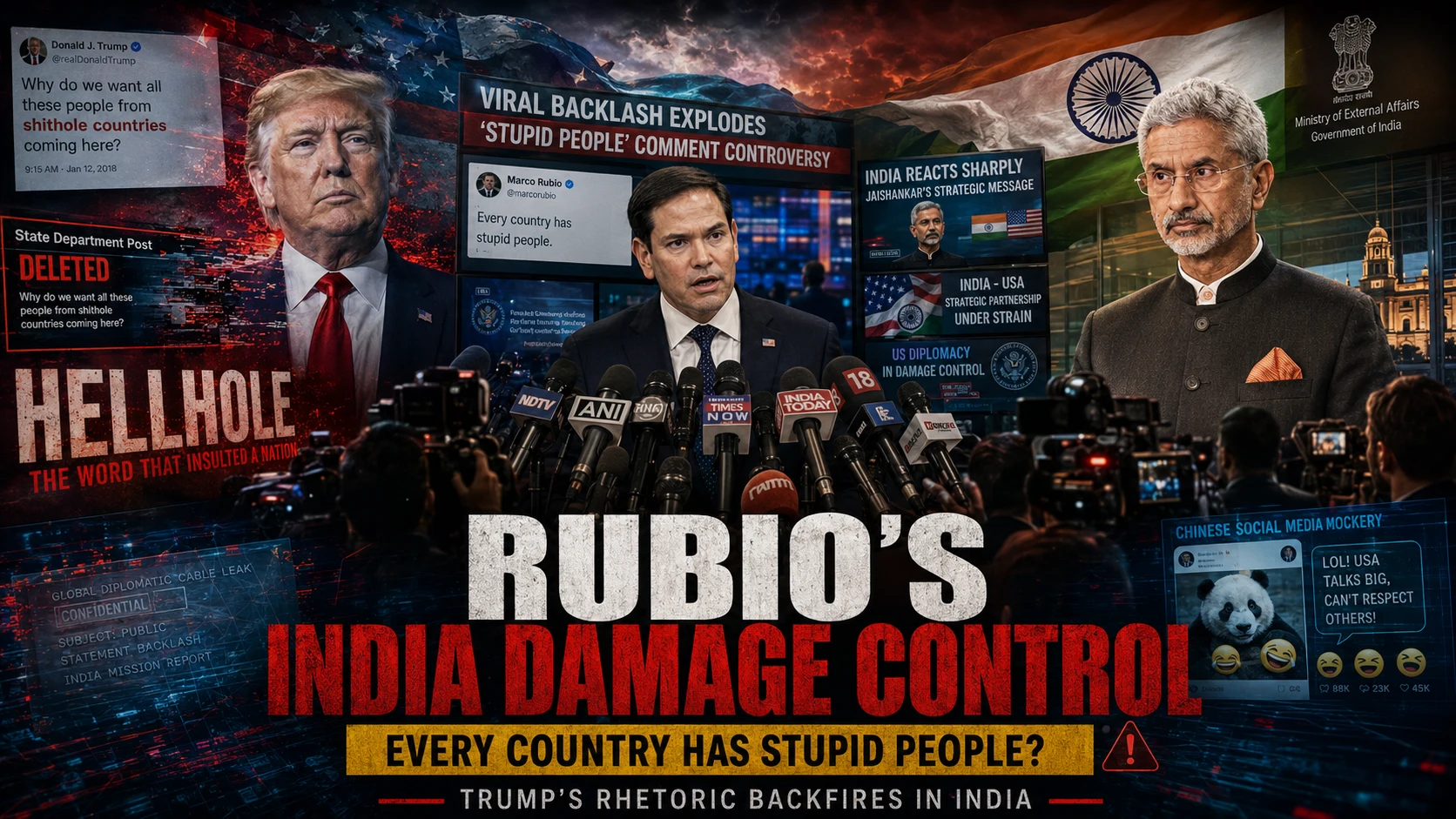
The Marco Rubio India visit stupid people comment controversy exploded because Rubio arrived in India to repair trust, but instead got dragged into defending Donald Trump’s rhetoric. Rubio’s four-day India visit from May 23 to May 26, 2026, happened after Trump’s China visit was widely seen as unsuccessful. After failing to get the response it wanted from China, the United States started refocusing on India again. Rubio was sent first, and the expectation was that more senior American officials — possibly even Trump himself later — would follow.
At the center of the storm was a simple contradiction. Trump publicly calls Prime Minister Narendra Modi a friend and says he “loves India,” while simultaneously sharing material calling India a “hellhole” country. That contradiction overshadowed everything else Rubio tried to achieve during meetings with S. Jaishankar in New Delhi.
The deeper issue was not one viral comment. It was the growing belief in India that anti-Indian rhetoric in the United States is no longer isolated internet trolling but something entering mainstream political language. And that is exactly what made one journalist’s question so dangerous for Rubio.
Sources: The Wall Street Journal
The Question That Changed Rubio’s India Visit
The turning point came when journalist Sidhant Sibal, Assistant Editor Foreign Affairs at WION News, directly asked Rubio about racist comments against Indians circulating on American platforms. While most journalists avoided the issue, Sibal forced Rubio into a public answer during the joint press conference with S. Jaishankar.
"Who said that…", US Secretary of State Rubio in response to my question on racism agaisnt Indians in US.
— Sidhant Sibal (@sidhant) May 24, 2026
US President Donald Trump had endorsed a post terming India "Hellhole" pic.twitter.com/UC37RYIcHK
Rubio responded by saying that “every country in the world has stupid people” who make dumb comments online. The statement was meant as damage control. Instead, it created a fresh controversy because critics immediately pointed out the obvious implication: if Trump himself had shared “hellhole” remarks about India, then Rubio’s own logic appeared to place the American president inside that category.
That single sentence transformed the visit from diplomacy into political mockery. Articles immediately appeared asking whether Rubio had accidentally called Trump stupid. The controversy spread beyond India and reached Chinese social media too, where Rubio was openly mocked for trying to defend comments made by his own president.
Rubio's remarks on racism question at Delhi presser, becomes part of conversation in Chinese social media, & american media. Conversation also taken up on social media by MAGA base. pic.twitter.com/FtAdcaOw04
— Sidhant Sibal (@sidhant) May 25, 2026
What made this worse was that Rubio is widely seen as a measured and experienced politician. Many even argued that if Rubio had once become president instead of Trump, American foreign policy might have been handled far more carefully. But the real damage was only beginning.
Sources: The Independent, India Today
Why This Became Personal for India
The real story here is not just about Donald Trump’s language. It is about how many Indians now feel that the United States casually tolerates hostility toward India while still expecting friendly relations.
The concern is no longer limited to anonymous social media accounts. Racism against Indians has now moved from online spaces into offline experiences too, with Indians travelling in Europe and the United States increasingly facing direct hostility. Another uncomfortable possibility is that some of these online campaigns may not even come from genuine Americans at all, but from fake accounts deliberately creating an atmosphere against Indians.
The problem kept growing because it was ignored for too long. It is similar to garbage piling up on streets when nobody cleans it immediately. Anti-Indian racism online was also ignored for years, and because no strong response came early enough, the atmosphere kept worsening.
This is why Rubio’s answer mattered so much in India. Indians were not simply asking for clarification about one social media post. They wanted to know whether American leaders understood how serious this had become. But the bigger question was how Trump’s own comments had already changed the atmosphere before Rubio even landed in India.
Trump’s “Hellhole” Comment Changed the Entire Context
Trump’s decision to share material calling India and China “hellhole” countries fundamentally changed how Rubio’s visit was perceived in New Delhi. Before Rubio even arrived, the atmosphere had already become defensive because many Indians saw the comments as unnecessary and insulting.
These comments came from the American side without any reason. India’s government, Prime Minister, and even ordinary Indians had not launched attacks against the United States, yet comments like “hellhole country” and “dead economy” still came from Trump’s side.
That context also explains why Trump’s China visit reportedly struggled. A leader who publicly insults China and then arrives asking for cooperation is unlikely to be taken seriously by Xi Jinping. The same logic now affects India too.
Against that backdrop, both Trump and Rubio later attempted to project a friendlier tone toward India. During celebrations marking the 250th anniversary of the US Declaration of Independence, US President Donald Trump joined live by phone at an event in Delhi attended by US Secretary of State Marco Rubio and US Ambassador to India Sergio Gor. In his remarks, Trump praised Prime Minister Narendra Modi as a great friend and described himself as a “big fan” of both India and Modi.
President Trump called me tonight. He had a clear message: “𝐈 𝐥𝐨𝐯𝐞 𝐏𝐫𝐢𝐦𝐞 𝐌𝐢𝐧𝐢𝐬𝐭𝐞𝐫 𝐌𝐨𝐝𝐢. 𝐖𝐞’𝐯𝐞 𝐧𝐞𝐯𝐞𝐫 𝐛𝐞𝐞𝐧 𝐜𝐥𝐨𝐬𝐞𝐫 𝐭𝐨 𝐈𝐧𝐝𝐢𝐚. 𝐈’𝐦 𝐚 𝐛𝐢𝐠, 𝐛𝐢𝐠 𝐟𝐚𝐧 𝐨𝐟 𝐏𝐫𝐢𝐦𝐞 𝐌𝐢𝐧𝐢𝐬𝐭𝐞𝐫 𝐌𝐨𝐝𝐢…” pic.twitter.com/jJBLhKdZhL
— Ambassador Sergio Gor (@USAmbIndia) May 24, 2026
Later, when another reporter referred to a question raised the previous day about allegedly racist and anti-India comments circulating online — including references to remarks amplified by Trump — Rubio defended the President by pointing to those same remarks from the Delhi event, emphasizing that Trump values India and admires Modi.
A day after I raised racism against Indians in US, US Secretary of State Marco Rubio confronted by US media over the same question in Delhi.pic.twitter.com/I86RsQYTHd
— Sidhant Sibal (@sidhant) May 25, 2026
But once political rhetoric reaches the level of publicly branding countries as “hellholes,” simple compliments are no longer enough to erase the memory.
And then Washington made an even bigger mistake.
Sources: India slams Trump Hellhole Remark: Impact on India, The Hindu
The State Department’s Deletion Made the Crisis Worse
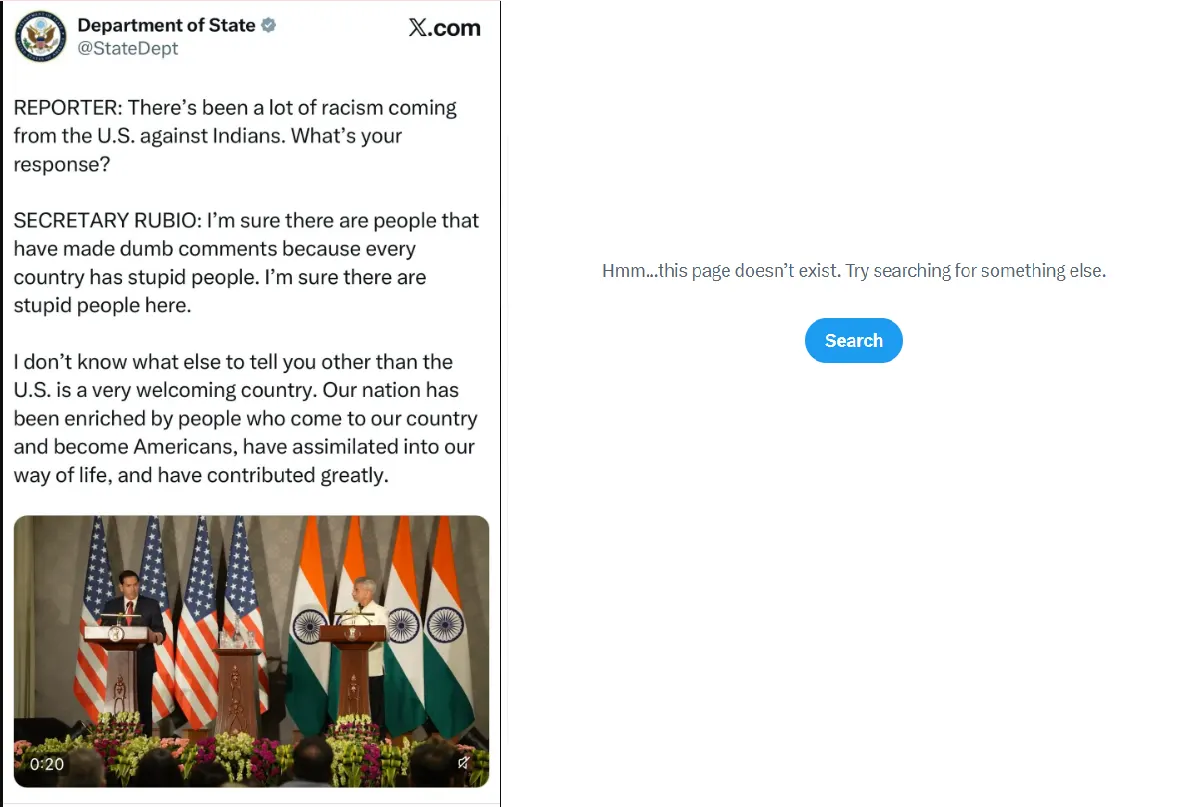
Screenshot of X post (Deleted) by US Department of State(@StateDept)
The official US State Department account posted Rubio’s response online and then deleted it after backlash exploded. The deletion transformed the entire controversy into a full “foreign policy disaster.” The United States unnecessarily spread racism against people from an important country like India and then completely failed to control the backlash.
Americans themselves began replying to the post asking whether criticism of Indians now automatically made someone “stupid.” Critics also pointed out that Rubio’s statement indirectly applied to Trump because Trump had amplified the original “hellhole” rhetoric. The backlash became so intense that the post disappeared entirely.
The deletion mattered because it exposed confusion inside the American response itself. If Rubio’s comments were correct, why remove them? If they were politically dangerous, why publish them in the first place? The removal gave the impression that the situation had spun beyond control.
Meanwhile, the controversy kept spreading internationally. Chinese social media users mocked Rubio. Indian audiences saw the deletion as proof that the issue had become embarrassing for Washington. And the broader strategic visit got buried beneath one communications crisis.
But the deepest contradiction still remained unresolved: how can Rubio defend India-US relations while Trump keeps creating fresh political damage?
Sources: WION News
Rubio’s Bigger Problem Was Donald Trump Himself
Rubio’s real challenge in India was that he was trying to stabilize relations while representing a president whose rhetoric keeps destabilizing them. Rubio’s measured diplomatic style stood in complete contrast to Trump’s unpredictable public messaging.
Rubio attempted reassurance. Trump simultaneously remained associated with “hellhole” comments, sanctions pressure, and inflammatory rhetoric. Even Trump’s later praise of Modi sounded inconsistent because Indians had already heard the earlier insults.
At the same time, Indian journalists are finally becoming more geopolitically aware and willing to ask direct questions to American officials. Earlier, such controversies might have passed quietly. Now journalists, social media users, and ordinary Indians are openly questioning American behavior instead of quietly ignoring it.
That shift matters because the issue is no longer remaining limited to diplomatic rooms alone. India may continue maintaining relations with the United States, but repeated public insults are clearly changing how many Indians view the relationship.
And for now, Rubio’s visit showed just how difficult it has become for American officials to separate diplomacy from Trump’s rhetoric.
Conclusion
The Marco Rubio India visit stupid people comment controversy was never just about one awkward sentence. It exposed a growing disconnect between America’s public diplomatic messaging toward India and the careless political rhetoric increasingly directed toward Indians and India itself.
Rubio arrived trying to repair confidence after Trump’s “hellhole” remarks and broader anti-India messaging. Instead, a direct question from Sidhant Sibal forced the issue into the open. Rubio’s attempt at damage control backfired, the State Department deleted its own post, and the visit became a symbol of confusion inside Washington’s India policy.
At the same time, the episode revealed something equally important about India. Indian journalists and audiences are no longer willing to quietly ignore public insults while maintaining diplomatic normalcy. The issue will eventually have to be raised more directly by the Indian government itself so that such comments are not casually repeated again in the future.
If American leaders continue speaking about India this way while simultaneously demanding deeper partnership in the Indo-Pacific, how long before Indian public anger starts affecting the political atmosphere surrounding the relationship?
FAQs
Why did the State Department delete the video of Marco Rubio in India?
The State Department deleted Rubio’s video after backlash erupted online over his “every country has stupid people” remark. Critics argued that Rubio’s statement indirectly included Donald Trump because Trump himself had amplified “hellhole” comments targeting India. The deletion made the controversy appear even more politically damaging because it suggested discomfort inside Washington over Rubio’s defense.
What did Trump say about India being a “hellhole”?
Trump shared material on his Truth Social platform that referred to India and China as “hellhole” countries. The comments triggered criticism in India because they came despite repeated American claims of friendship toward India. These remarks created long-term damage in public perception.
Why was Sidhant Sibal’s question important?
Sidhant Sibal was the only journalist in the press conference who directly confronted Rubio about anti-Indian racism coming from the United States. His question forced the issue into the center of the visit instead of allowing discussions to remain purely diplomatic. The exchange quickly became internationally viral.
Did Marco Rubio defend anti-Indian racism?
Rubio did not openly defend racism. He argued that every country has people who say foolish things online and emphasized that the United States remains an open society. However, many Indians felt the response failed to strongly condemn the growing hostility against Indians.
Has this controversy damaged India-US relations?
Trump’s rhetoric has clearly harmed trust between India and the United States. While official engagement continues, repeated insults and inflammatory comments are affecting how many Indians now view the relationship. Rebuilding that confidence may become difficult if such comments continue.
Closing Question
If the United States keeps demanding deeper strategic partnership with India while allowing public rhetoric that openly insults Indians, will New Delhi eventually be forced to separate geopolitical cooperation from political trust?
Share Your Views in the Comments below.
Explore more about World Affairs and Indian Affairs.