Table of Contents
Why Taiwan’s Anti-India Campaign Shocked So Many People
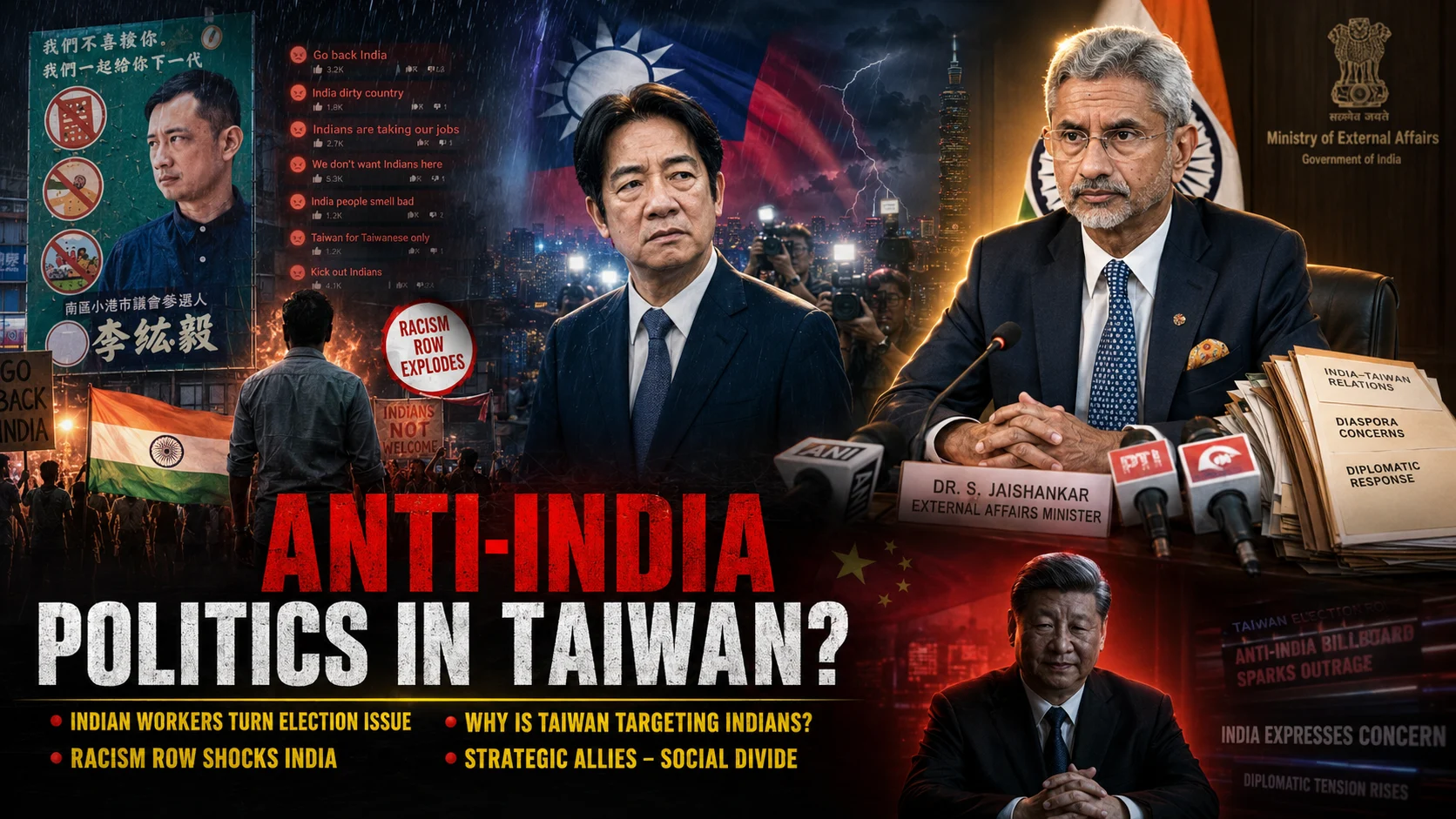
The biggest shock in the Taiwan anti India racism controversy was not just the billboard itself — it was the realization that openly targeting Indians may now be seen as an electoral strategy in Taiwan. In Kaohsiung, an election candidate displayed a poster showing the Indian flag upside down alongside the image of a turbaned Indian man with messaging against Indian workers entering Taiwan. The campaign messaging was explicit: people from outside should not come to Taiwan.
What disturbed many Indians was that this rhetoric had moved beyond anonymous social media posts into real-world political campaigning. Online anti-Indian racism is no longer staying online. It is now spilling into public life and electoral politics. The issue also feels deeply personal because the targeting is based on appearance and identity, not ideology. Whether someone is left-wing or right-wing does not matter when racism is aimed at how Indians look as a subcontinental people.
This trend increasingly resembles what has already happened in countries like Nepal and Bangladesh, where speaking against India and Indians has often become politically useful. The fear now is whether Taiwan is entering the same pattern where anti-Indian messaging becomes an easy route to publicity and votes.
But the billboard controversy was only the visible part of a much larger problem.
Sources: Asia News Network, Republic
How Indian Workers Became an Election Weapon in Taiwan
The real issue underneath the Taiwan anti India racism debate is not only prejudice — it is the growing use of Indian workers as a political tool inside Taiwan. Taiwan desperately needs workers because of declining birth rates and labor shortages, yet politicians continue portraying Indian workers as a threat.
In February 2024, India and Taiwan signed a migration and mobility MOU to allow Indian workers into sectors like manufacturing, agriculture, construction, and caregiving. Soon after, protests emerged against Indian migrant workers. Demonstrations in 2023 openly demanded that Indian workers should not enter Taiwan.
The sharpest insight in the controversy is that broader fears around migration are increasingly being redirected specifically toward Indians. Taiwan already faces anxieties surrounding migrant labor and missing workers, but instead of discussing those problems generally, sections of Taiwanese politics began turning Indian labor into the symbol of those fears.
Building hostility toward workers even before they arrive is completely wrong. Taiwan’s population is shrinking, labor shortages are increasing, and workers will eventually have to come from somewhere. Yet hostility is already being normalized.
And once electoral incentives become attached to this issue, diplomacy alone becomes much weaker.
Sources: Taipei Times, Taipei Times, Wikipedia, Hindustan Times
Why This Debate Matters Far More to India Than Taiwan
The most important part of this controversy is not the billboard or even the protests — it is the long-term message India receives from Taiwan. Taiwan sees India as strategically important, especially when it comes to long-term security and defense calculations involving China.
The issue goes far beyond normal diplomatic language. If China ever launches major aggression against Taiwan, India’s role could become extremely important in Taiwan’s survival. That is why the contradiction inside Taiwan becomes so serious.
Taiwan’s own defense and strategic establishment understands the danger. Joseph Wu, Taiwan’s Secretary-General of National Security Council, publicly condemned the anti-Indian campaign and said he felt ashamed that politicians were using such tactics simply for attention. When it comes to defense and long-term geopolitical planning, there is broad agreement in Taiwan that India is an extremely important country.
But at the same time, anti-Indian controversies continue resurfacing. This kind of politics ultimately gives China “brownie points” because it damages India’s image inside Taiwan and weakens goodwill between the two sides. If Indians increasingly begin associating Taiwan with racism and hostility, then future support inside India for helping Taiwan may also weaken.
And that is where Taiwan’s internal contradiction becomes impossible to ignore.
Sources: Firstpost
The Contradiction Taiwan Cannot Escape
Taiwan wants Indian workers, stronger relations with India, and deeper long-term cooperation — but parts of its politics still resist accepting Indians socially. That contradiction runs through the entire controversy.
The backlash became sharper once discussions expanded toward bringing larger numbers of workers into sectors like manufacturing and construction. The controversy increasingly focused on appearance, skin color, and stereotypes instead of discussing worker skills, contribution, or labor shortages.
Former Labor Minister Hsu Ming-chun apologized after suggesting that workers from Northeast India might fit Taiwan better because of similarities in skin color and habits. That was not viewed as a simple verbal mistake, but as evidence of a deeper racial mindset that still exists even inside advanced societies.
Skin color changes because of geography and melanin, not because one group is more human than another. If someone urgently needed blood or an organ tomorrow, an Indian, African, American, or European could all help because human beings are fundamentally the same internally.
And once race becomes politically useful, social media begins amplifying everything even further.
Sources: NDTV
When Online Hate Starts Changing Real Politics
One of the biggest dangers in this controversy is that online anti-Indian hate never stays confined to the internet for long. Once people repeatedly consume hateful narratives online, they eventually begin implementing those attitudes offline in politics and society.
Online discourse can also be manipulated far more easily than most people realize because users often do not know who is actually creating or spreading narratives. People from other countries can interfere in another country’s online political discussions without citizens even realizing who is shaping the discourse.
This situation increasingly resembles how anti-Israel hate campaigns spread online and eventually entered mainstream political discussions. Prime Minister Benjamin Netanyahu has already spoken publicly about where much of this online hate originates. India now faces a similar challenge and will eventually have to openly address organized anti-Indian hate on social media platforms.
Think about what that means. A country facing demographic decline and labor shortages is simultaneously discussing migration agreements while sections of its politics demonize the very workers it may soon depend upon.
That contradiction now threatens to spill directly into Taiwan’s larger strategic goals.
Why Taiwan’s Strategic Goals Are Colliding With Domestic Politics
The Taiwan anti India racism controversy ultimately exposes the growing gap between Taiwan’s strategic needs and parts of its domestic political culture. Taiwan’s leadership understands that stronger relations with India matter economically, diplomatically, and strategically. But domestic politics does not always follow strategic logic.
Anti-Indian rhetoric is becoming politically useful because it generates attention, outrage, and visibility during elections. The danger is not only diplomatic embarrassment. The larger risk is that repeated controversies gradually damage India’s public perception of Taiwan itself.
Part of the concern here is psychological. If Indians repeatedly see posters, protests, and racial controversies coming from Taiwan, then support for closer cooperation may eventually weaken at the public level as well. Racism cannot simply be dismissed as “online noise” because online narratives eventually influence real-world politics and behavior.
The issue therefore is no longer just about one campaign poster or one ministerial apology. It is about whether Taiwan can separate legitimate labor concerns from racialized politics before long-term damage is done to a relationship both sides increasingly need.
FAQs
Why is there a protest against Indian workers in Taiwan?
The protests emerged after India and Taiwan signed a migration and mobility MOU in 2024 to bring Indian workers into sectors like manufacturing and construction. Broader fears around migration and labor shortages gradually became redirected specifically toward Indians. Political campaigns and social media debates intensified those fears further.
Who was involved in the Taiwan billboard controversy?
An election candidate in Kaohsiung displayed a campaign poster showing the Indian flag upside down alongside the image of a turbaned Indian man while opposing Indian workers entering Taiwan. The controversy became symbolic of how anti-Indian rhetoric had moved from social media into public political campaigning.
What did Taiwan’s labor minister say about Northeast Indian workers?
Former Labor Minister Hsu Ming-chun suggested that workers from Northeast India would fit Taiwan more easily because of similarities in skin color and habits. The statement later triggered criticism and an apology because many viewed it as racially insensitive.
Why does Taiwan still need migrant workers despite these protests?
Taiwan faces declining birth rates, labor shortages, and a shrinking population. Taiwan will eventually need foreign workers from somewhere, including workers from India, even while sections of politics continue opposing them.
How does this controversy affect India-Taiwan relations?
Repeated anti-Indian controversies could damage Indian public opinion toward Taiwan. If racism increasingly becomes associated with Taiwan in Indian public consciousness, then future goodwill and support for closer cooperation may weaken over time.
Closing Question
If anti-Indian rhetoric continues becoming politically useful inside Taiwan, will Indians eventually begin questioning why they should support deeper cooperation with a society where sections of politics openly campaign against them?
Share Your Views in the Comments below.
Explore more about Indian Affairs and World Affairs.