Table of Contents
US Operative Arrested in India: Why This Case Matters
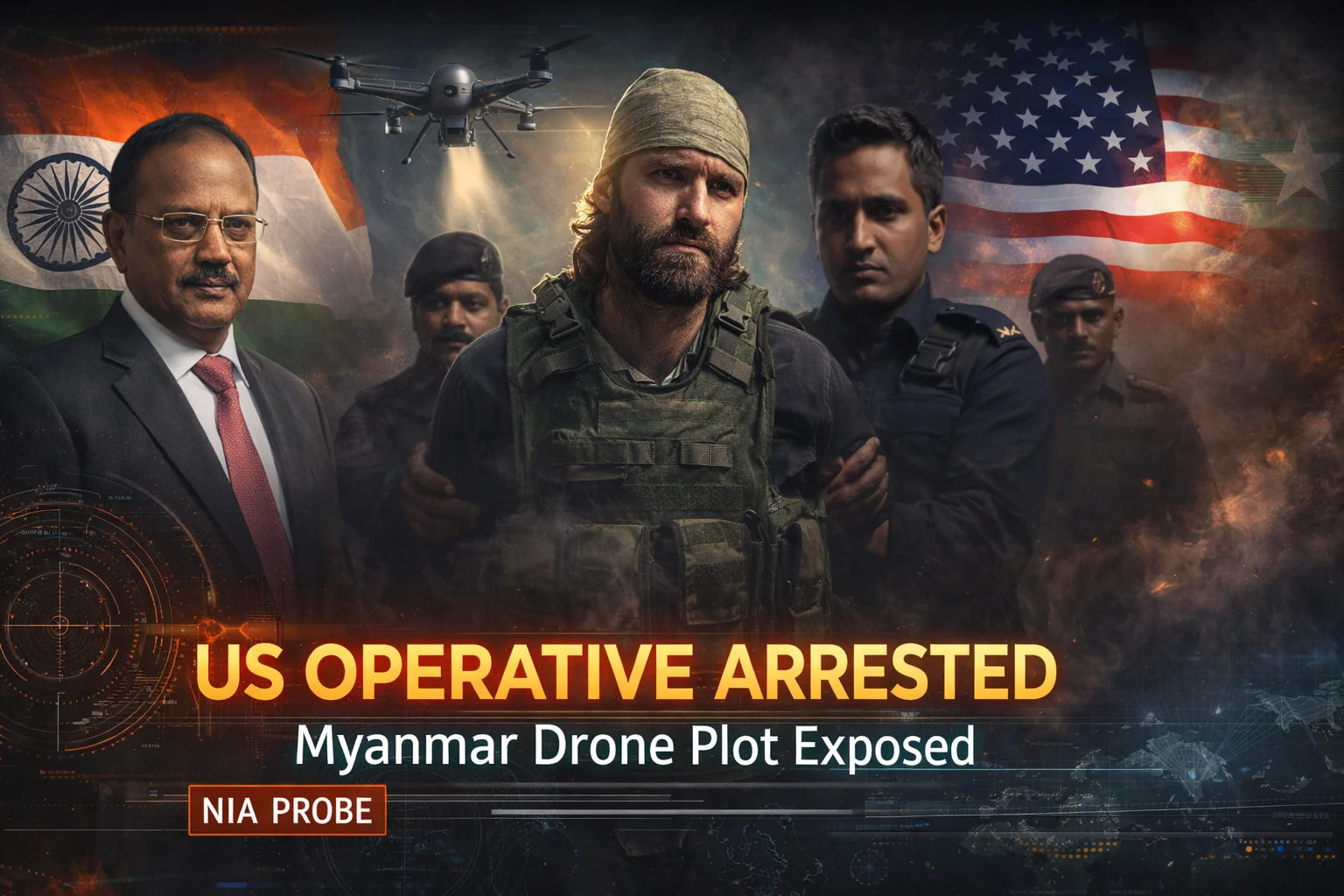
The case of a US operative arrested in India has triggered serious geopolitical questions, especially given where and how it unfolded.
Near the India–Myanmar border in Mizoram, India’s National Investigation Agency (NIA) detained multiple foreign nationals, including an American citizen and several Ukrainians.
The allegation?
A drone-linked operation connected to activities inside Myanmar.
This was not a routine arrest.
It was a signal.
Sources: The Telegraph
Who Is Matthew VanDyke and Why He Stands Out
At the center of the case is Matthew VanDyke.
Officially, he is not part of the US government.
- Not a soldier
- Not a CIA officer
- Not a formal state actor
But his background tells a different story.
VanDyke has reportedly been involved in multiple global conflict zones:
- Libya
- Syria
- Ukraine
He is also the founder of Sons of Liberty International, which has conducted training and advisory missions in conflict regions.
But one of the most significant aspects of his profile comes from his own public statements.
VanDyke has claimed that he has been running covert operations in Venezuela since 2019, working with rebel commanders to challenge the government of Nicolás Maduro.
According to these claims:
- He participated in intelligence and operational planning
- Missions such as Operation Aurora were linked to these efforts
- Some operations were intentionally kept secret for years
He later stated that these activities were part of a broader effort to support regime change and “restore freedom.”
These claims are partially supported by open-source reporting that confirms his involvement in covert activities with Venezuelan rebels.
I've been running covert operations with a Venezuelan rebel commander since 2019.
— Matthew VanDyke (@Matt_VanDyke) January 10, 2025
You've read about our missions in the media, such as Operation Aurora, but nobody knew who did it.
The Venezuelan team and I agreed to reveal this today.
We'll continue until #Venezuela is free. pic.twitter.com/OMyi0ay6Sm
This is important.
Because it establishes a pattern:
Conflict zones → rebel training → covert operations → deniable involvement
And that pattern is what makes his presence near Myanmar strategically significant.
Sources: Times of India, Zee News, India Today
What Happened in India: NIA Investigation Explained
The group reportedly entered India on tourist visas.
From there, the movement pattern is critical:
- Arrival in cities like Kolkata and Delhi
- Movement toward Guwahati
- Entry into Mizoram without proper permits
- Illegal crossing into Myanmar
According to initial findings, the objective was not directed against India.
Instead, the alleged plan involved:
- Training armed groups in Myanmar
- Specifically in drone warfare techniques
That detail changes the scale of the issue.
This was not tourism.
This was operational movement.
Sources: NDTV
Why Myanmar Is at the Center of This Operation
To understand the motive, you need to go back to 2021.
In that year, Myanmar experienced a military coup.
The elected government was removed, and a military regime took control.
Since then:
- Protests emerged
- Civilian casualties were reported
- Armed resistance groups formed
At the same time, Myanmar’s leadership moved closer to China.
For the United States, this creates a strategic problem.
Sanctions have not worked.
Diplomatic pressure has not changed the regime.
So what remains?
Indirect influence.
Support to opposition groups.
And that is where operations like these fit in.
Sources: ASPI The Strategist
India’s Position: Security First, Neutrality Always
India’s approach is fundamentally different.
India shares a direct border with Myanmar.
That changes the stakes.
For India, the priority is not regime change.
It is stability.
Why?
Because instability in Myanmar directly impacts:
- Northeast India security
- Cross-border migration
- Insurgency risks
This is why India acted.
Not against any country.
But to protect its own national security framework.
This was deliberate.
The Bigger Geopolitical Game Behind the Incident
The arrest of a US operative arrested in India is not just a law enforcement issue.
It reflects a broader pattern.
Modern geopolitics increasingly uses:
- Informal actors
- Proxy groups
- Indirect intervention methods
This creates layers of deniability.
And complexity.
Because no one is officially responsible.
Yet everyone is involved.
This incident sits exactly at that intersection.
What Happens Next: Legal and Diplomatic Fallout
The next phase is crucial.
Countries involved include:
- United States
- Ukraine
Ukraine has already raised concerns and may push for consular access and release.
The US has acknowledged awareness of the situation but has not provided detailed comments.
For India, the decision ahead is sensitive:
- Proceed strictly under domestic law
- Or consider diplomatic pressure
This will test India’s strategic balance.
Sources: Hindustan Times
Conclusion
The story of a US operative arrested in India reveals more than a single incident.
It exposes how modern conflicts operate:
Indirectly.
Quietly.
Across borders.
For India, the message is clear.
Geography matters.
Security comes first.
And neutrality does not mean passivity—it means control over what happens within your borders.
The implications of this case will unfold over time.
But one thing is certain:
This was not just an arrest.
It was a geopolitical signal.
FAQs
Why was a US operative arrested in India?
He was allegedly involved in a drone-related operation linked to activities in Myanmar, including training local armed groups.
Was this operation targeting India?
No direct evidence suggests India was the target. However, the activities raised serious national security concerns.
What is the role of NIA in this case?
The National Investigation Agency is India’s primary counter-terrorism body responsible for investigating such high-risk cases.
Why is Myanmar important in this case?
Myanmar is experiencing political instability after a military coup, making it a focal point for geopolitical influence.
Could this affect India-US relations?
It could create temporary tension, but both countries are likely to manage the situation diplomatically.
What Should India Do Next?
The case of a US operative arrested in India raises critical strategic questions.
- Should India take a strict legal route regardless of external pressure?
- Can neutrality be maintained amid covert geopolitical activity?
- And how should India respond to foreign actors using its territory for external conflicts?
Share Your Perspective in the Comments below.
Because in geopolitics, control over your territory defines true sovereignty.
Explore more about Defense & Security, Indian Affairs and World Affairs.