
Table of Contents
Why the US Iran Peace Deal $300 Billion Debate Changed Everything
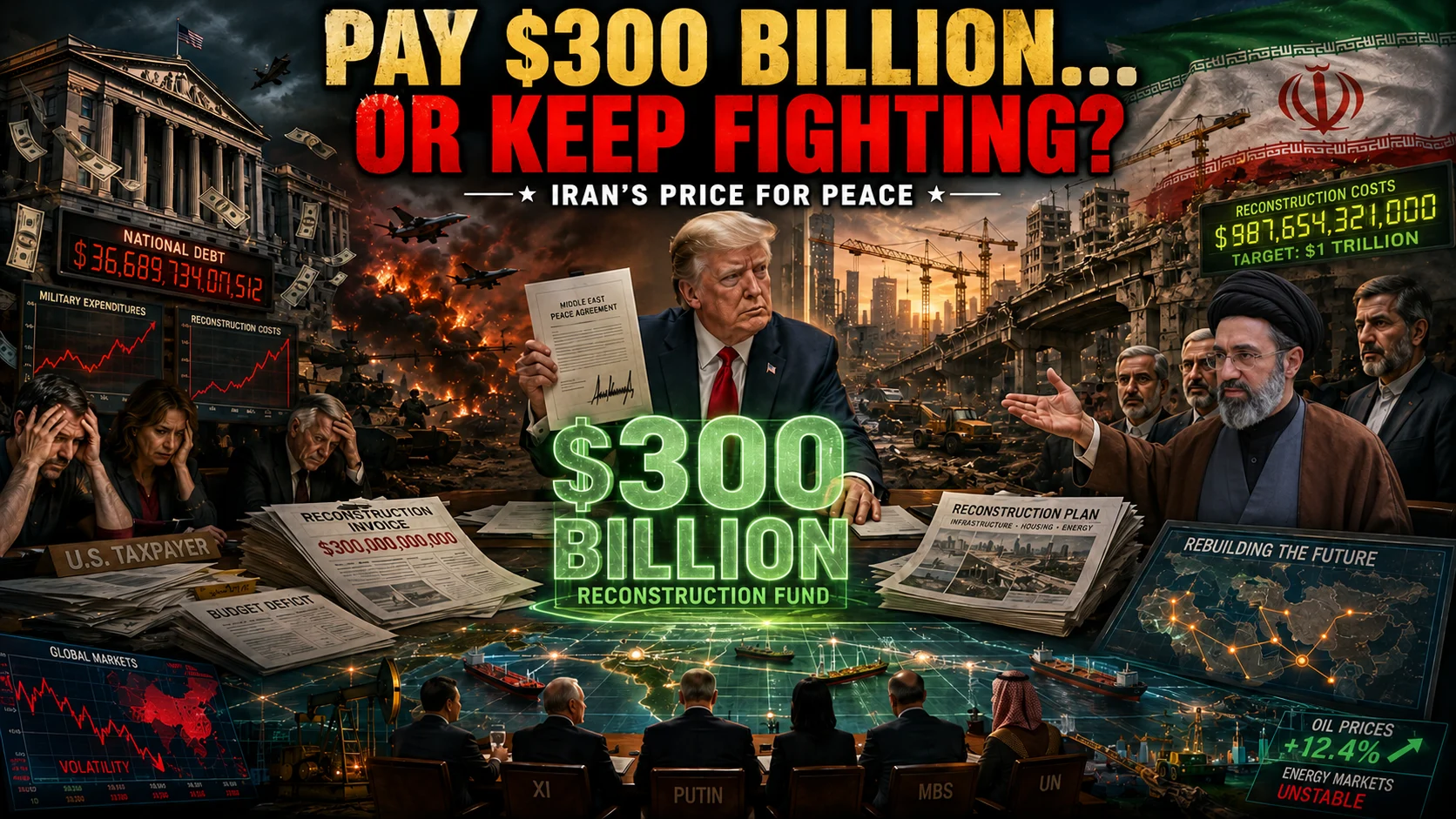
The biggest story in the emerging US Iran peace deal $300 billion negotiations is not the ceasefire itself but the extraordinary price Iran says must be paid to end the conflict.
The war between the United States and Iran has now stretched for almost 90 days. Iran claims that its infrastructure has suffered extensive damage during the conflict. Bridges have reportedly been destroyed, buildings have been damaged, and reconstruction has become the central issue in the peace talks.
What makes the situation remarkable is the scale of the money being discussed. When Donald Trump launched Operation Epic Fury, few expected the final bill to reach anywhere between $50 billion and $100 billion. Yet today, the conversation is no longer about military operations. It is about reconstruction demands that start at $300 billion and, according to some Iranian officials, could eventually rise toward $1 trillion.
Reports about a post-war reconstruction fund have transformed the debate from military strategy into economic survival. But the bigger question is why Iran believes it can demand such a massive amount in the first place.
Sources: The Times of India, The Times of Israel, New York Times
The Demand That Turned a War Into a Financial Crisis
The central dispute is no longer military. It is financial.
Iran’s position is based on the scale of destruction it says the country has suffered. Iranian officials argue that reconstruction requires at least $300 billion and that this figure represents only the minimum amount necessary to rebuild the country.
The reasoning is linked directly to Iran’s economy. Iran’s nominal GDP is roughly $300 billion. From that perspective, Tehran’s argument is that reconstruction should at minimum compensate for an entire year’s worth of economic output. Some Iranian officials even suggest that the final reconstruction requirement could eventually approach $1 trillion.
More importantly, the demand is presented not as a request but as a condition. The message is simple: either reconstruction funding is provided or the war will not end.
This is why the issue has become politically explosive in the United States. Critics argue that American taxpayers already paid for the military campaign. Now they may also be expected to finance reconstruction. Many online reactions express disbelief that billions were spent bombing Iran and that hundreds of billions more may now be required to rebuild it.
But the financial burden is only part of the story. The deeper issue is that Washington may have fewer options than it initially imagined.
Sources: Wikipedia – List of Countries by GDP (Nominal)
Why This Matters Far More to India Than Most People Realize
For Indian readers, this story carries a lesson that goes beyond the immediate conflict.
One of the strongest themes emerging from this crisis is the enormous cost of modern warfare. The debate is no longer about who launched more strikes or who controls more territory. It is about what happens after the fighting. The reconstruction bill itself is becoming one of the most important strategic questions.
India has now moved into the group of the world’s largest economies, with an economy valued at roughly $4.1 trillion. That comparison highlights the scale of what Iran is demanding. A single reconstruction package of $300 billion is not a symbolic amount. It is equivalent to Iran’s entire annual economic output.
The broader argument is that military operations create costs that continue long after the battlefield phase ends. Once infrastructure is destroyed, someone must eventually pay for rebuilding it. This becomes clear when comparing the costs of the war with the reconstruction demands now being discussed.
For India, the significance lies in understanding how geopolitical conflicts increasingly become economic contests. The numbers involved demonstrate how quickly military decisions can evolve into financial obligations measured in hundreds of billions of dollars.
Yet even after all these costs, the United States still faces a strategic dilemma it may not be able to escape.
The Negotiation That Revealed How Few Options Remain
The most striking reality is that the United States may now be trapped between two difficult choices.
Washington can either accept some version of Iran’s reconstruction demands or continue a conflict that is already proving extraordinarily expensive. Critics of the war argue that neither path offers a clear victory.
The possibility of dramatic escalation has also entered the conversation. If the United States truly wanted to force a decisive outcome, it would have to consider far more destructive options. However, even the use of weapons of mass destruction might not guarantee victory and would almost certainly trigger condemnation from countries around the world.
Trump has rejected the use of nuclear weapons for now. No comparable assurance has emerged from Israel. At the same time, another concern continues to surface. Even if an agreement is reached, Iran may simply agree not to pursue nuclear weapons for the next 10 to 15 years. After that period expires, critics argue that Iran could eventually become a nuclear-weapon state anyway.
The result is a negotiation where neither side appears capable of achieving everything it originally wanted. That reality helps explain why many Americans have started comparing this strategy with a very different approach taken years earlier.
Why Americans Are Comparing Trump to Obama
The comparison with Barack Obama has become one of the most politically damaging parts of the debate.
Many Americans are now comparing the outcomes of Obama’s nuclear deal with the consequences of the current conflict. Supporters of that comparison argue that the earlier agreement delayed Iran’s nuclear ambitions without producing a major war.
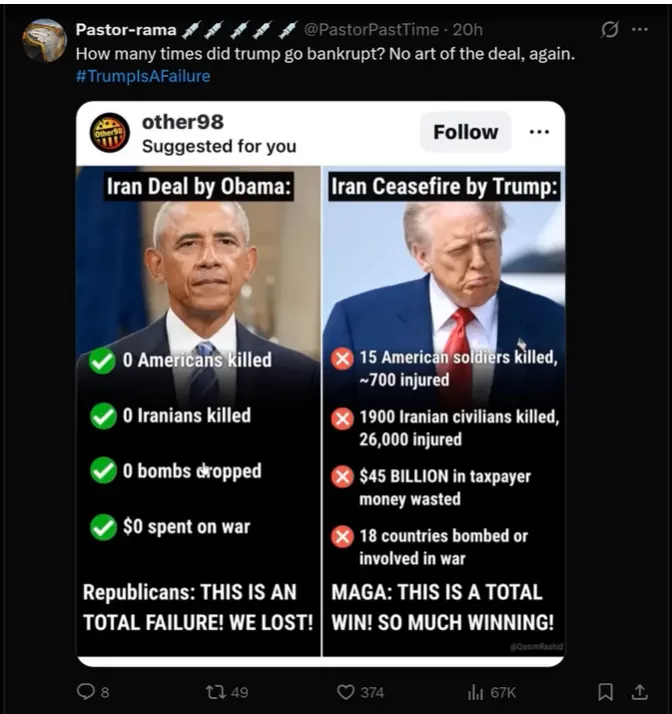
Screenshot of X post by Pastor-rama (@PastorPastTime)
The numbers most often cited are intended to highlight that contrast. Critics claim that 15 American soldiers were killed and roughly 700 were injured during the conflict. They also point to approximately 2,000 Iranian civilians killed and around 25,000 injured. Financially, confirmed costs already exceed $45 billion and could reach between $50 billion and $60 billion once aircraft losses, destroyed drones, damaged military assets, and other operational expenses are included.
The criticism becomes even sharper when the broader regional impact is considered. As many as 18 countries were directly or indirectly bombed or drawn into the conflict. Some critics therefore conclude that history will judge Trump harshly for the decision to pursue this path.
That comparison becomes especially significant when discussing the controversial $400 million payment made during the Obama era.
Donald Trump: " Remember when [Obama] filled up a 757 with billions of dollars of cash and sent it to Iran?…I realized the presidency is very powerful, when you could put over a billion dollars in an airplane and fly it over and give it to a foreign country that's your enemy." https://t.co/Gu3tuLueL0 pic.twitter.com/tQsr1gLsqv
— Home of the Brave (@OfTheBraveUSA) May 29, 2026
Trump frequently criticized Obama for sending money to Iran and at times claimed that the amount was $757 million, but the documented figure for the initial payment was $400 million. The explanation is that before the 1979 Iranian Revolution, Iran had purchased weapons from the United States and paid for them in advance. Those weapons were never delivered after relations collapsed. The money remained frozen for decades while interest accumulated. The $400 million represented part of those previously frozen funds rather than a direct transfer of taxpayer money.
This is why many Americans are now making a direct comparison between a $400 million arrangement that helped produce a deal and a situation where $50–60 billion has already been spent while Iran is demanding at least $300 billion more. But that comparison ultimately leads back to the same question confronting Trump today.
Sources: CNN
The Choice Trump No Longer Seems Able to Avoid
Trump’s choice can be reduced to very simple terms: pay or continue fighting.
One option is to move toward a reconstruction arrangement and attempt to secure a peace agreement. The other is to reject Iran’s demands and continue the conflict. There are no easy alternatives left.
Critics of the current situation argue that asking other countries to share the burden will not solve the problem. If Washington asks Europe or Japan to contribute billions toward rebuilding Iran, those countries are likely to ask a simple question: if the United States bombed Iran, why should they pay for reconstruction?
That skepticism explains why many observers believe the financial burden will ultimately fall on American taxpayers. Some reactions even warn that taxes could eventually be increased to help cover America’s growing debt and the costs generated by the conflict.
The stakes are enormous. If the war continues, the total American bill could eventually reach somewhere between $300 billion and $400 billion. The damage to the global economy would be separate from that figure. Additional civilian deaths would be separate as well.
This was the central warning.
War is expensive. In today’s world, it can become so expensive that even military victories create financial problems that last for years.
FAQs
What is the $300 billion reconstruction fund for Iran?
The proposed fund is a post-war reconstruction mechanism for rebuilding damaged Iranian infrastructure. Iranian officials argue that at least $300 billion is needed, while some suggest the figure could eventually rise much higher.
Why is the US Iran peace deal $300 billion proposal controversial?
The controversy centers on who will pay. Critics argue that American taxpayers already financed the military campaign and may now be expected to contribute toward reconstruction as well.
Why are some people discussing a $1 trillion figure?
Some Iranian officials consider $300 billion the minimum requirement and believe reconstruction costs could eventually approach $1 trillion.
Why are Americans comparing Trump and Obama?
The comparison focuses on cost and outcomes. Critics argue that Obama’s approach involved a diplomatic agreement and a disputed $400 million payment, while the current conflict has produced casualties, destruction, and costs measured in tens of billions of dollars.
Could the war continue instead of reaching a deal?
Yes. Two possibilities dominate the debate: either reconstruction funding becomes part of a settlement or the conflict continues with potentially much higher economic and human costs.
Conclusion
The emerging US Iran peace deal $300 billion negotiations have transformed a military conflict into a debate about reconstruction, taxpayer costs, and political consequences. What began as a war that many expected to cost tens of billions of dollars has evolved into a discussion involving demands for at least $300 billion and possibly much more. Iran argues that reconstruction is necessary before peace can be secured. Critics argue that American taxpayers are being asked to shoulder both the cost of the war and the cost of rebuilding afterward. Meanwhile, comparisons with the Obama-era approach continue to grow louder as casualties, financial losses, and long-term strategic questions dominate the debate.
If Iran insists that reconstruction funding is the price of peace, will future governments—including those in countries such as India—view the economic cost of war as a greater deterrent than military risk itself?
Share Your Views in the Comments below.
Explore more about World Affairs.




Marco Rubio India Visit ‘Stupid People’ Comment Decoded