Table of Contents
Why Guwahati Matters More Than Delhi
The most important fact about the Sanae Takaichi India visit is not that Japan’s Prime Minister is coming to India—it is where she is expected to meet Prime Minister Narendra Modi.
Reports indicate that Guwahati, Assam, is being considered as the venue for the July 2026 summit. At first glance, this looks like a symbolic correction of history after former Japanese Prime Minister Shinzo Abe’s planned 2019 visit was cancelled amid protests against the Citizenship (Amendment) Act. But that explanation is too shallow.
The sharper reality is that Guwahati sits at the center of India’s Northeast strategy. Japan has already financed connectivity projects across the region through JICA (Japan International Cooperation Agency)-backed initiatives, while India has increasingly treated the Northeast as the operational gateway for the Act East Policy. The summit’s location places diplomatic attention directly on one of India’s most strategically sensitive regions.
This was deliberate.
But why is Japan suddenly attaching so much strategic value to a region thousands of kilometers from Tokyo?
Sources: The Assam Tribune
Why the Quiet Financial Shift Matters More Than Headlines
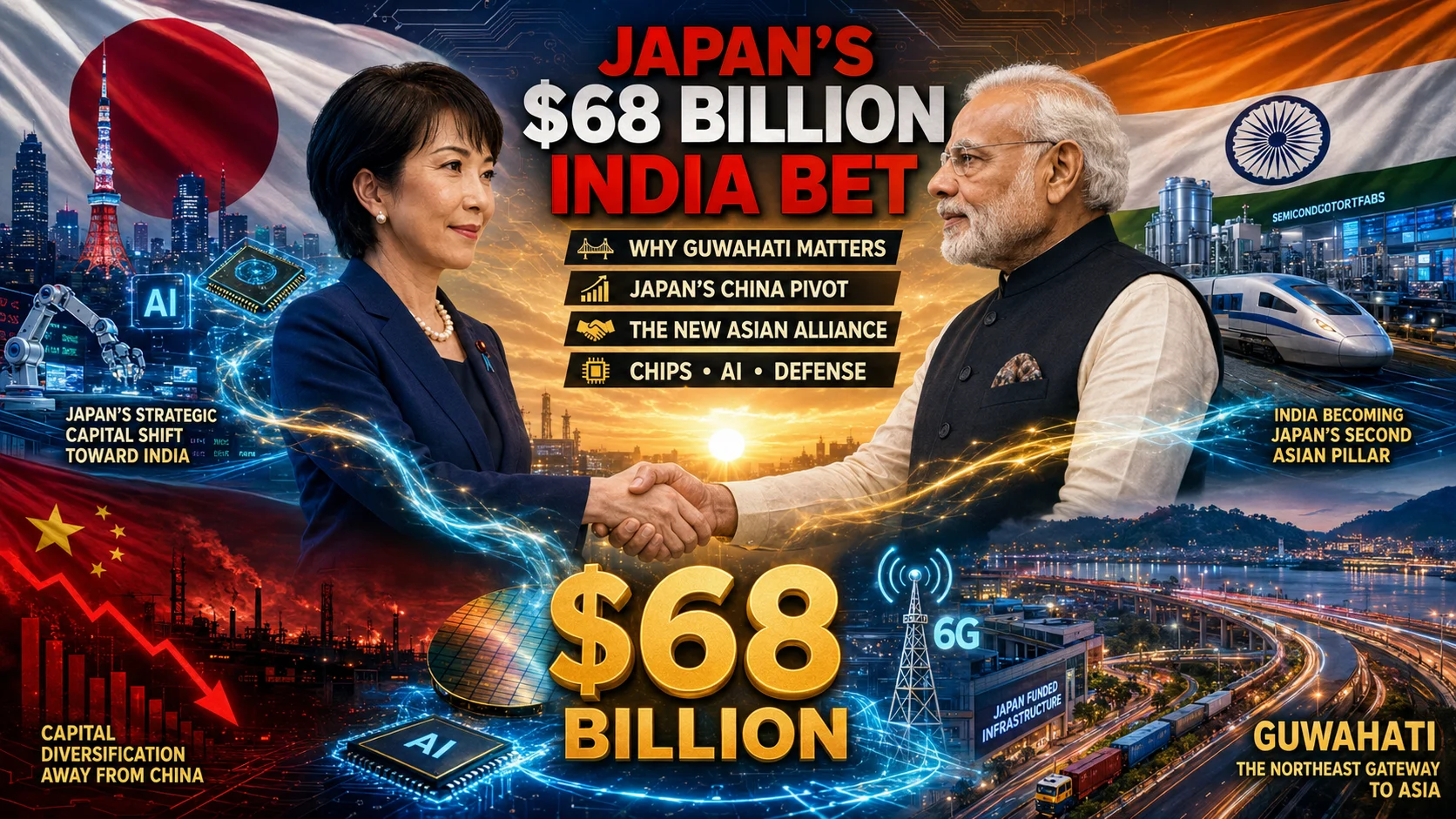
The headline number is impressive: Japan and India have agreed on a new private-sector investment target of 10 trillion yen, roughly $68 billion, over the next decade.
The deeper story is where Japanese capital is becoming less enthusiastic.
Japan’s three megabanks—Mitsubishi UFJ Financial Group, Sumitomo Mitsui Banking Corporation, and Mizuho Financial Group—have reportedly reduced their combined corporate loan exposure in China by about 40% over five years. Japanese regional banks have also shrunk their physical branch networks in China by roughly 20%. Meanwhile, Mizuho’s securities arm acquired a majority stake in Avendus Capital in India during December 2025.
This does not mean Japan is abandoning China. Evidence shows Japanese investment into China remains substantial, and many corporations continue operating under an “In China, for China” strategy.
However, the direction of new strategic capital is becoming harder to ignore.
When shrinking Chinese loan books, a doubled India investment target, and a summit centered on Guwahati appear simultaneously, they suggest something larger than diversification. Japan increasingly seems willing to place economic capital, technological partnerships, and geopolitical attention on the same map. If that interpretation is correct, the Northeast is no longer peripheral—it is becoming the test case for a new Asian strategic order. What does that mean for India?
Sources: NDTV, India Today, The Economic Times
Why India Is the Biggest Winner—For Now
India’s opportunity extends far beyond foreign direct investment.
Japan’s challenge is increasingly demographic rather than financial. The country faces a growing shortage of skilled technology workers, while India produces approximately 1.5 million engineering graduates annually. That reality helps explain why the latest investment framework emphasizes semiconductors, artificial intelligence, advanced manufacturing, and digital cooperation rather than simply low-cost assembly lines.
The evidence is already visible. IIT Hyderabad, Japan’s Sharp Semiconductor Innovation Corporation (SSIC), and WiSig Networks successfully conducted Beyond-5G and 6G field trials in May 2025. Suzuki has committed roughly $8 billion to India and has begun producing the e Vitara EV in Gujarat for exports to Europe and Japan. The Mumbai-Ahmedabad Bullet Train project continues progressing, with the breakthrough of Mountain Tunnel-07 in Palghar marking another milestone.
Mumbai-Amdavad Bullet Train Project achieves another milestone 🇮🇳
— Ashwini Vaishnaw (@AshwiniVaishnaw) June 2, 2026
🛤️ 3rd mountain tunnel breakthrough in Maharashtra within 5 months.
📍Dahanu Taluka, Palghar pic.twitter.com/vhZcU4vgmP
For India, the biggest gain is not capital.
It is access to technologies that historically remained concentrated inside advanced industrial economies.
The risk, however, is assuming these benefits arrive automatically. To maximize this opening, India must connect Northeast infrastructure, semiconductor ambitions, engineering talent, and manufacturing ecosystems into one coherent strategy. Otherwise, investment targets will generate headlines without creating long-term strategic leverage.
But economics alone cannot explain Tokyo’s urgency.
Sources: Reuters, Press Information Bureau, The Economic Times, The Times of India
The Defense Decision That Changes Everything
Japan’s April 2026 decision to scrap its postwar ban on lethal weapons exports may become one of the most consequential policy shifts in Asia this decade.
The new framework allows exports of equipment including fighter jets, missiles, destroyers, and combat drones to approved partner countries that have defense transfer agreements with Japan. India falls within that group and officially welcomed the decision through Ministry of External Affairs spokesperson Randhir Jaiswal.
Most coverage treats this as a standalone defense reform. That misses the larger picture.
The same government that expanded military export flexibility is simultaneously increasing investments in India, strengthening technology cooperation, and elevating Northeast India within bilateral diplomacy.
What emerges is not merely defense cooperation.
It is an economic-security partnership where finance, technology, infrastructure, and strategic planning reinforce each other. The next question is how these separate pieces fit together.
Sources: News on AIR, Business Standard, Impact on India: India Japan Defense Deals 2026
From Bullet Trains to 6G: The New Economic Security Partnership
Many observers still think India-Japan relations are primarily about bullet trains.
That framework is now outdated.
The Mumbai-Ahmedabad high-speed rail corridor remains important, but the relationship increasingly stretches into semiconductors, AI systems, advanced wireless technologies, electric vehicle manufacturing, and supply-chain resilience.
The 6G field trials at IIT Hyderabad demonstrate that cooperation is moving into frontier technologies. Suzuki’s Gujarat manufacturing ecosystem shows how India is becoming an export platform rather than merely a domestic market. Blackstone’s record $13.1 billion Asia-focused fund prioritizing India and Japan further reflects growing investor confidence in this corridor.
Meanwhile, China’s rising incomes are gradually reducing one of the advantages that originally attracted global manufacturers.
The competition is no longer simply about cheap labor.
It is increasingly about engineering capability, scale, political trust, and strategic alignment.
And that brings us back to Guwahati.
Sources: Fortune India, News18
The Real Meaning of the Takaichi-Modi Summit
The conventional interpretation is that the Sanae Takaichi-Modi summit will focus on investment announcements and diplomatic symbolism.
The stronger interpretation is that Japan is attempting to institutionalize its role inside a strategically critical geography of India.
Guwahati’s significance comes from what surrounds it: the Northeast, India’s Act East ambitions, connectivity toward Southeast Asia, and the broader security concerns linked to the Siliguri Corridor. When combined with Tokyo’s expanded defense posture, deep-tech cooperation, banking shifts, and the new $68 billion investment target, the summit begins to look less like a routine bilateral meeting and more like a statement about Asia’s future balance of power.
Japan is not replacing China with India. The evidence does not support that claim.
What the evidence does suggest is something more important: Tokyo is steadily building a second strategic pillar in Asia, and India is becoming that pillar. The significance of the summit is not the money being announced. It is the geography being prioritized and the long-term strategic architecture being constructed around it.
FAQ
When is Japanese PM Sanae Takaichi visiting India?
Reports indicate that Prime Minister Sanae Takaichi is arranging her first official India visit for early July 2026, with July 1 and Guwahati, Assam, emerging as the likely focal point of the trip.
Why is Japan investing $68 billion in India?
Japan and India have agreed on a new 10 trillion yen investment target covering semiconductors, AI, advanced manufacturing, and strategic technologies. The initiative reflects both economic opportunity and broader supply-chain resilience goals.
What is Japan’s new policy on lethal weapons exports?
Japan approved new guidelines in April 2026 ending its longstanding ban on lethal weapons exports. The change allows sales of military equipment to approved partner countries that have defense transfer agreements with Tokyo.
Why was Shinzo Abe’s 2019 Guwahati visit cancelled?
Shinzo Abe’s planned December 2019 visit was cancelled because of widespread protests linked to the Citizenship (Amendment) Act across Assam and other parts of Northeast India.
Is Japanese capital leaving China for India?
Not completely. Japanese banks have reduced lending exposure in China and increased focus on India, but major Japanese firms continue maintaining significant operations and investments inside China.
Closing Question
If Japan is now treating Northeast India as a strategic frontier rather than a peripheral region, how should India reshape its Act East Policy before this window of opportunity closes?
Share Your Views in the Comments below.
Explore more about Economy & Trade.