Table of Contents
A Mediation That Is Breaking Down
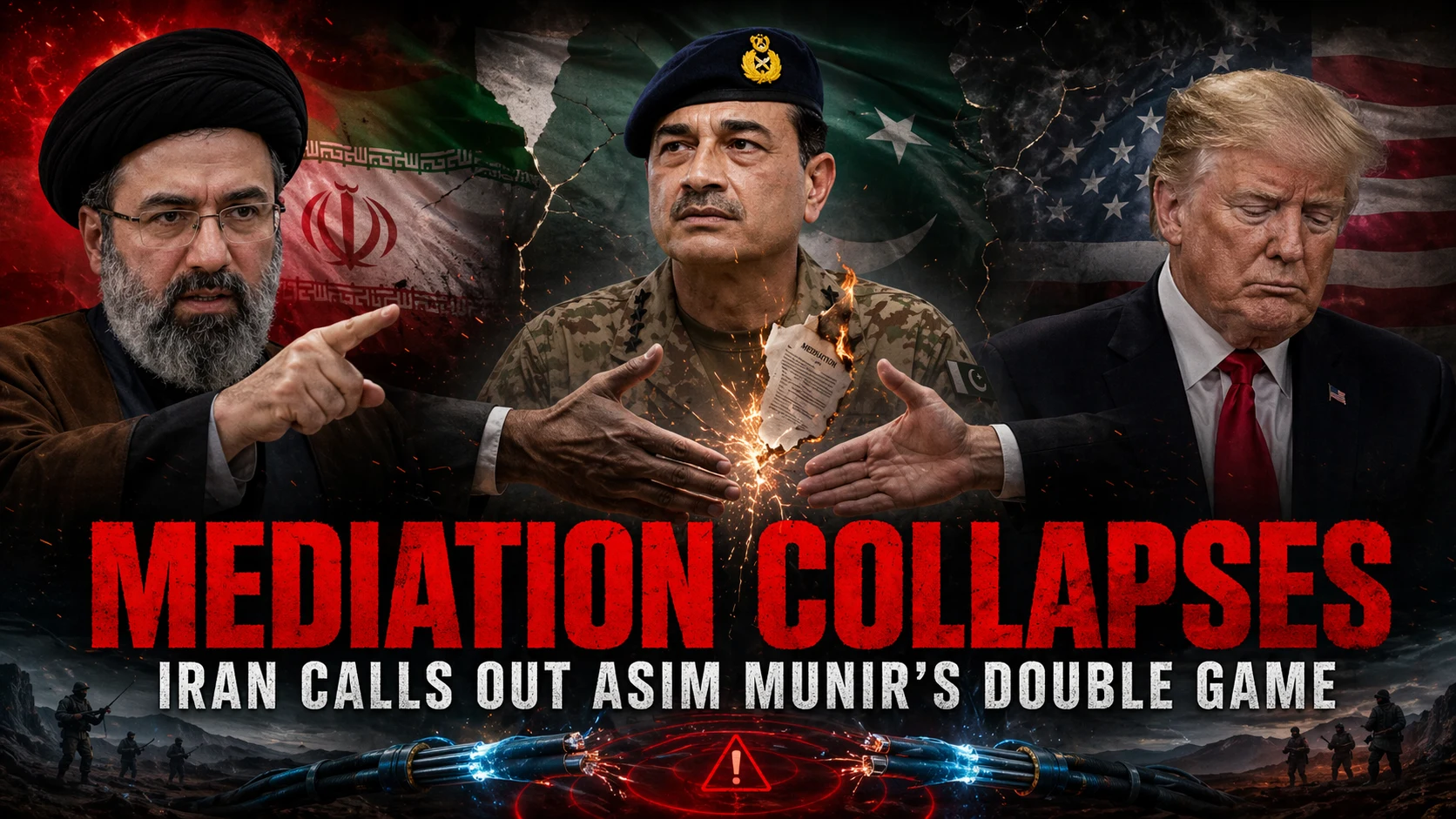
The keyword Asim Munir US Iran Mediation is now at the center of a growing geopolitical fracture.
What was projected as a diplomatic bridge is now being openly questioned.
Iran has begun publicly casting doubt on Pakistan’s role as a mediator between Tehran and the United States.
And this is not coming from external analysts.
This is coming from Iranian state media itself.
That matters.
Because when state-backed platforms start exposing a mediator, it signals something deeper:
Trust has collapsed.
Sources: Open Magazine
Iran’s Public Exposure of Pakistan
Iranian media has moved beyond subtle criticism.
It is now directly targeting:
- Asim Munir
- Shehbaz Sharif
The accusation is clear:
Pakistan is playing a “double game.”
According to Tehran:
- Pakistan is structurally aligned with the United States
- Mediation efforts are biased
- Negotiations are not producing results
This isn’t a diplomatic disagreement.
This is an accusation of strategic manipulation.
Sources: News18
The “Failed Message” Controversy
This is where things shift from rhetoric to operational breakdown.
🚨 BIG! Iranian state TV hits out at Pakistan, accusing it of a “double game” and targeting Army Chief Asim Munir over a pro-US tilt.
— Megh Updates 🚨™ (@MeghUpdates) April 22, 2026
Tehran claims its proposal was routed via Pakistan to the US with no response, while alleging Islamabad is pushing new US-backed demands.
=>… pic.twitter.com/ExVqZ8M099
Iran claims:
It sent a structured diplomatic message through Asim Munir intended for Donald Trump.
But according to Iranian state-linked commentary:
- No response was received
- No confirmation of delivery exists
- The message may never have reached Washington
That detail matters.
Because mediation depends on one thing:
Reliable communication.
If messages are filtered—or not delivered at all—
then mediation is not neutral.
It is compromised.
Why Mediation Is Structurally Biased
Here’s what that means.
Mediation only works when the mediator is trusted by both sides.
But look at the structure:
- United States is significantly more powerful than Iran
- Pakistan has deep military, economic, and political ties with Washington
This creates an imbalance.
In theory, a mediator should:
- Balance power asymmetry
- Amplify weaker party concerns
- Ensure neutrality
Instead, Iran believes the opposite is happening.
That Pakistan is:
- Reinforcing US leverage
- Filtering Iranian positions
- Prioritizing its own strategic interests
This was predictable.
The Deeper Trust Deficit
This is not just about one failed message.
It is about accumulated distrust.
Iran’s concerns include:
- Pakistan’s long-term alignment with the US
- Military dependencies (equipment, funding)
- Political signaling favoring Washington
Even historically, this perception exists.
Only briefly, during Imran Khan’s (Former PM of Pakistan) tenure, Pakistan was seen as relatively independent.
That phase ended.
Now, the perception is clear:
Pakistan is not a neutral actor.
And once that perception sets in—
mediation collapses.
Escalation Risks: From Borders to Internet Cables
The breakdown is not just diplomatic.
It is operational.
Border Escalation
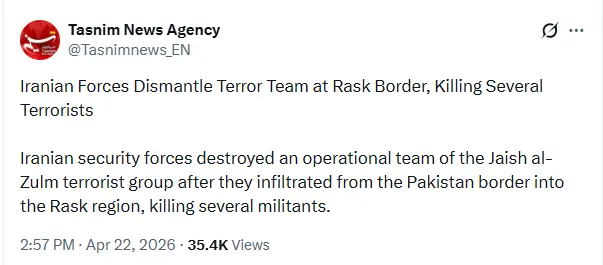
Screenshot of X post by Tasnim News Agency (News agency associated with IRGC)
Iran has reported:
- Terror infiltration from Pakistan
- Neutralization of militants near the Rask region
Groups like Jaish al-Zulm are being cited.
This adds a security dimension to the diplomatic crisis.
The Internet Cable Threat
Here’s where things become more serious.
Iran has hinted at targeting:
Undersea internet cables in the Persian Gulf
These cables are:
- The backbone of global internet traffic
- Critical for financial systems
- Essential for global communications
Cutting them would not just affect one country.
It would impact entire regions.
However, constraints exist:
- Strong naval protection (including US presence)
- Risk of global backlash
- Technical difficulty
Still, even discussing this possibility signals escalation.
Sources: Iran International
India’s Strategic Contrast
This is where India takes a different path.
India’s approach has been consistent:
No third-party mediation.
For example:
- During Operation Sindoor-related tensions
- India insisted on direct bilateral engagement
No intermediaries.
No external filters.
That approach avoids exactly this problem:
Communication distortion.
This is deliberate.
What Changes Next in the Conflict
The situation is now entering a new phase.
Key shifts:
- Pakistan’s credibility as mediator is weakening
- Iran is signaling distrust openly
- Communication channels are fragmenting
Which leads to a critical question:
What happens when mediation fails?
Usually, two outcomes emerge:
- Direct negotiations
- Or escalation
Given current tensions—
both remain possible.
FAQs
Why does Iran distrust Pakistan as a mediator?
Iran believes Pakistan is biased toward the United States. This perception comes from long-standing military and economic ties between Pakistan and the US, which undermine neutrality in negotiations.
What is the “failed message” issue?
Iran claims it sent diplomatic instructions via Asim Munir to Donald Trump, but no response was received. This raises concerns that the message may not have been delivered properly.
Is Pakistan playing a double game?
Iranian state media suggests so. The allegation is that Pakistan is publicly mediating while privately aligning with US strategic interests.
Has Iran threatened global internet infrastructure?
Yes, Iranian discussions have included the possibility of targeting undersea cables in the Persian Gulf, though practical and political constraints make this difficult.
Why doesn’t India mediate in such conflicts?
India prefers direct bilateral engagement, avoiding third-party mediation to prevent miscommunication and strategic distortion.
What Happens If Mediation Completely Fails?
If the current breakdown in Asim Munir US Iran Mediation continues, the next phase becomes unavoidable.
Will the United States, Iran, and Israel shift toward direct negotiations?
Or will the communication gap widen into a larger regional escalation?
Because history shows one pattern clearly:
When intermediaries lose credibility,
either diplomacy becomes direct—
or conflict becomes decisive.
So the real question is:
Will global powers correct the mediation failure in time,
or are we already moving toward a point where dialogue is no longer enough?
Share Your Views in the Comments below.
Explore more about Defense & Security and World Affairs.