Table of Contents
A Quiet Pact With Massive Implications
The India Russia RELOS Pact is not just another defense agreement.
It is a structural shift.
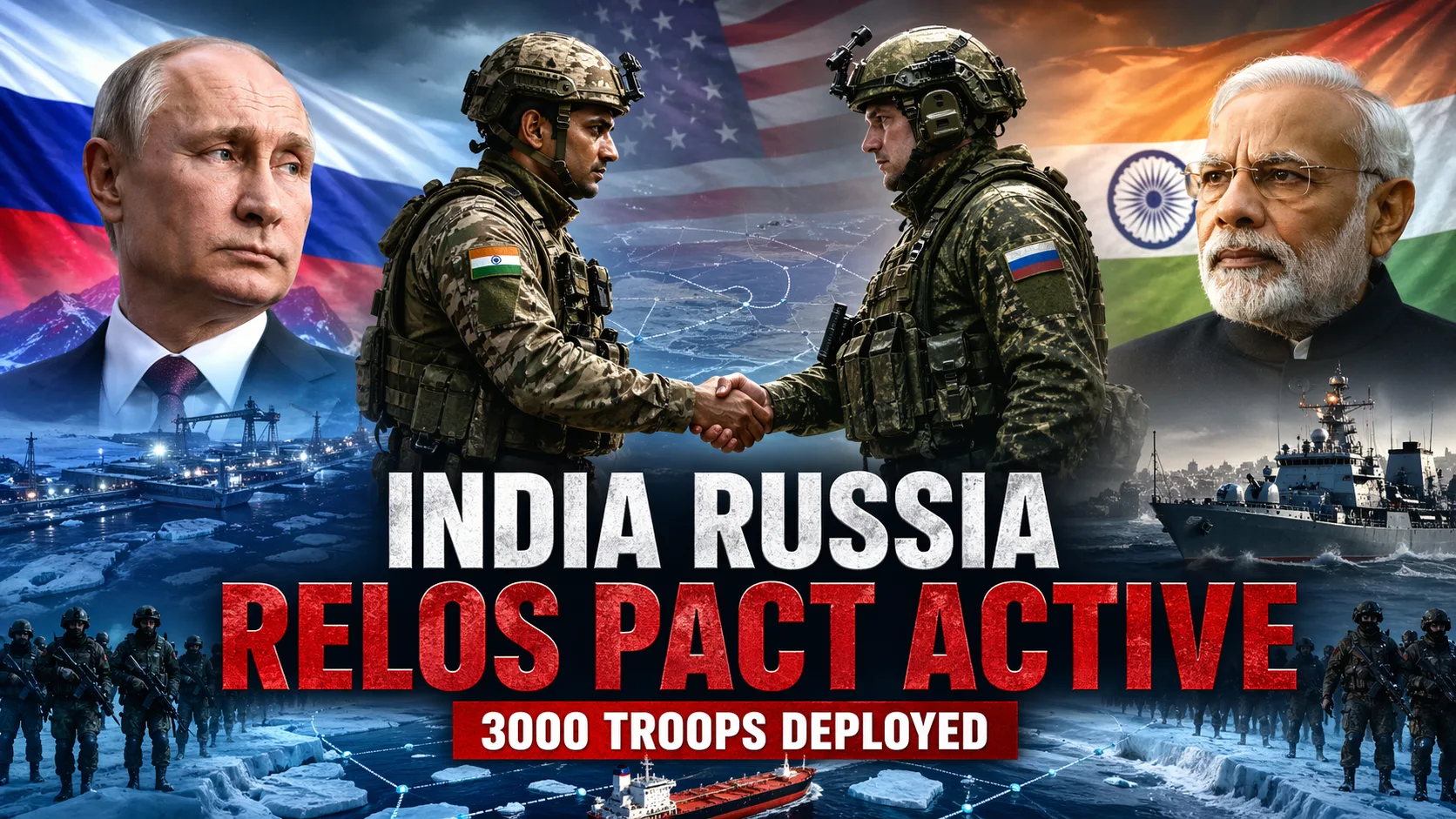
At a time when global alliances are becoming unpredictable, India and Russia have operationalized a pact that allows up to 3,000 troops to be stationed in each other’s territory.
This is not symbolic cooperation.
This is operational integration.
And that difference matters.
Sources: The Statesman
What the India Russia RELOS Pact Actually Allows
The India-Russia RELOS Pact (RELOS – Reciprocal Exchange of Logistics Support) includes several key provisions:
- Up to 3,000 soldiers stationed in each other’s territory
- Deployment of 5 warships and multiple aircraft
- Access to bases, ports, and logistics infrastructure
- Applicability during both war and peacetime
That last point is critical.
This was deliberate.
Because it ensures continuity—regardless of global conditions.
Sources: NDTV, The Economic Times
RELOS vs LEMOA: Why This Is Deeper
To understand the significance, compare it with the LEMOA (Logistics Exchange Memorandum of Agreement) India signed with United States.
LEMOA allows:
- Refueling
- Repair access
- Temporary logistical support
But it does not allow permanent stationing of troops.
That is the difference.
Under RELOS:
- Troops can remain deployed long-term
- Military assets can be pre-positioned
- Response time drops significantly
This is a deeper level of trust.
And a higher level of commitment.
The “Stationing” Clause That Changes Everything
The word “stationing” is where this pact transforms.
Temporary exercises are routine.
Permanent or semi-permanent presence is not.
Here’s what changes:
- Faster joint military response
- Reduced deployment costs
- Continuous operational readiness
Imagine a scenario where immediate support is needed.
Instead of deploying forces from scratch—
They are already there.
This is a force multiplier.
The Barter System: Oil for Logistics
One of the most underreported aspects is the payment mechanism.
Maintaining foreign troops is not free. Costs include housing, food supplies, fuel, maintenance of equipment, port usage, and base infrastructure support for stationed personnel and military assets.
The pact allows cost reimbursement through:
- Goods
- Services
- Even oil exchanges
Instead of direct cash payments for these operational expenses, both sides can settle dues through equivalent value exchanges.
For example, if Russia stations troops in India, the cost of logistics provided by India can be offset through crude oil supplies or other strategic resources, instead of direct monetary transfers.
This bypasses traditional financial constraints.
Especially important for Russia, which faces international payment restrictions.
This is not just logistics.
It is a system designed to sustain long-term military presence without financial friction.
It is financial innovation in defense cooperation.
Murmansk and the Arctic Breakthrough
One location defines the long-term impact:
Murmansk
Located in northern Russia above the Arctic Circle, Murmansk is one of the few year-round ice-free Arctic ports, making it a critical hub for military and commercial operations in the Arctic region.
This port gives India:
- Access to the Arctic region
- Entry into emerging Northern Sea Routes
- Strategic presence in a resource-rich zone
Under the India-Russia RELOS Pact, Indian naval and research vessels can use Russian military infrastructure like Murmansk for refueling, maintenance, and logistical support, effectively giving India operational access without owning a base.
This is significant because India does not geographically border the Arctic, and without such agreements, sustained naval presence in this region would be extremely difficult.
Why does this matter?
Because melting ice in arctic is opening new trade corridors.
And with that—
New power equations.
Very few countries operate here:
- United States
- China
- Russia
- Canada
- European countries like Norway and Sweden
Now, India gains a functional entry point into the Arctic theatre—something previously limited to a handful of countries.
That is a major shift.
Sources: Republic
Timing Matters: The U.S. Factor
This pact did not happen in isolation.
It comes at a time when:
- Questions are being raised about Donald Trump’s South Asia policy
- U.S. engagement with Pakistan has increased
- Strategic trust between India and the U.S. shows signs of strain
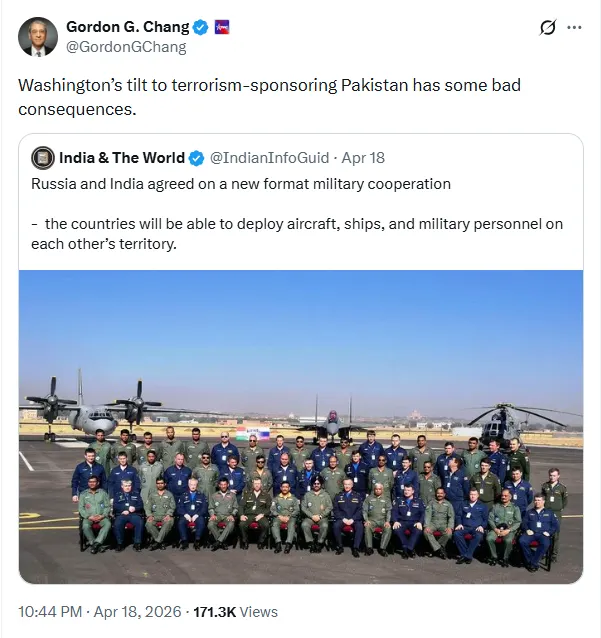
Screenshot of X Post by Gordon G. Chang (Lawyer, Geopolitical Analyst)
So why now?
Because timing is strategy.
This move sends a clear signal:
India is diversifying.
Not abandoning—but balancing.
INDRA Exercises and Future Military Integration
The impact will be visible first in joint exercises like INDRA.
Expect:
- Larger troop participation
- More complex drills
- Integrated command structures
This is where theory becomes practice.
And practice builds capability.
Strategic Autonomy: India’s Core Signal
At its core, the India Russia RELOS Pact reflects one principle:
Strategic autonomy.
India is not aligning exclusively with any one bloc.
Instead, it is:
- Expanding partnerships
- Strengthening redundancy
- Building independent capability
This is not reactive.
This is proactive positioning.
Conclusion
The India Russia RELOS Pact is more than a military agreement.
It is a geopolitical statement.
By enabling:
- 3,000 troop stationing
- Arctic access via Murmansk
- A barter-based logistics system
India is reshaping how defense partnerships function.
And more importantly—
Where it stands in the global order.
This is not about choosing sides.
It is about ensuring options.
Because in a world of shifting alliances—
Flexibility is power.
FAQs
What is the India Russia RELOS Pact?
The India-Russia RELOS Pact allows mutual military logistics support, including troop stationing and asset deployment.
How many Russian troops will be stationed in India?
Up to 3,000 troops can be stationed at any given time under the agreement.
Is the RELOS agreement more significant than LEMOA?
Yes. Unlike LEMOA, RELOS allows long-term stationing of troops, making it structurally deeper.
Can the Indian Navy use Russia’s Arctic ports?
Yes. Access to Murmansk enables Indian naval presence in the Arctic.
How does the barter system work in this pact?
Logistics costs can be compensated through goods or services, including oil, instead of direct financial transactions.
What Should You Watch Next?
The next phase of this story will unfold through:
- Expansion of India-Russia joint exercises
- Real deployment visuals from Arctic access points
- Shifts in U.S. strategic posture toward South Asia
- India’s evolving role across multi-alignment blocs
Each development will reveal whether this pact remains tactical—
Or becomes transformational.
Stay focused on the signals.
Because this is not a one-time move.
It is the beginning of a longer strategic trajectory.
Explore more about Defense & Security and World Affairs.