Table of Contents
Why India Became the 6th Largest Economy
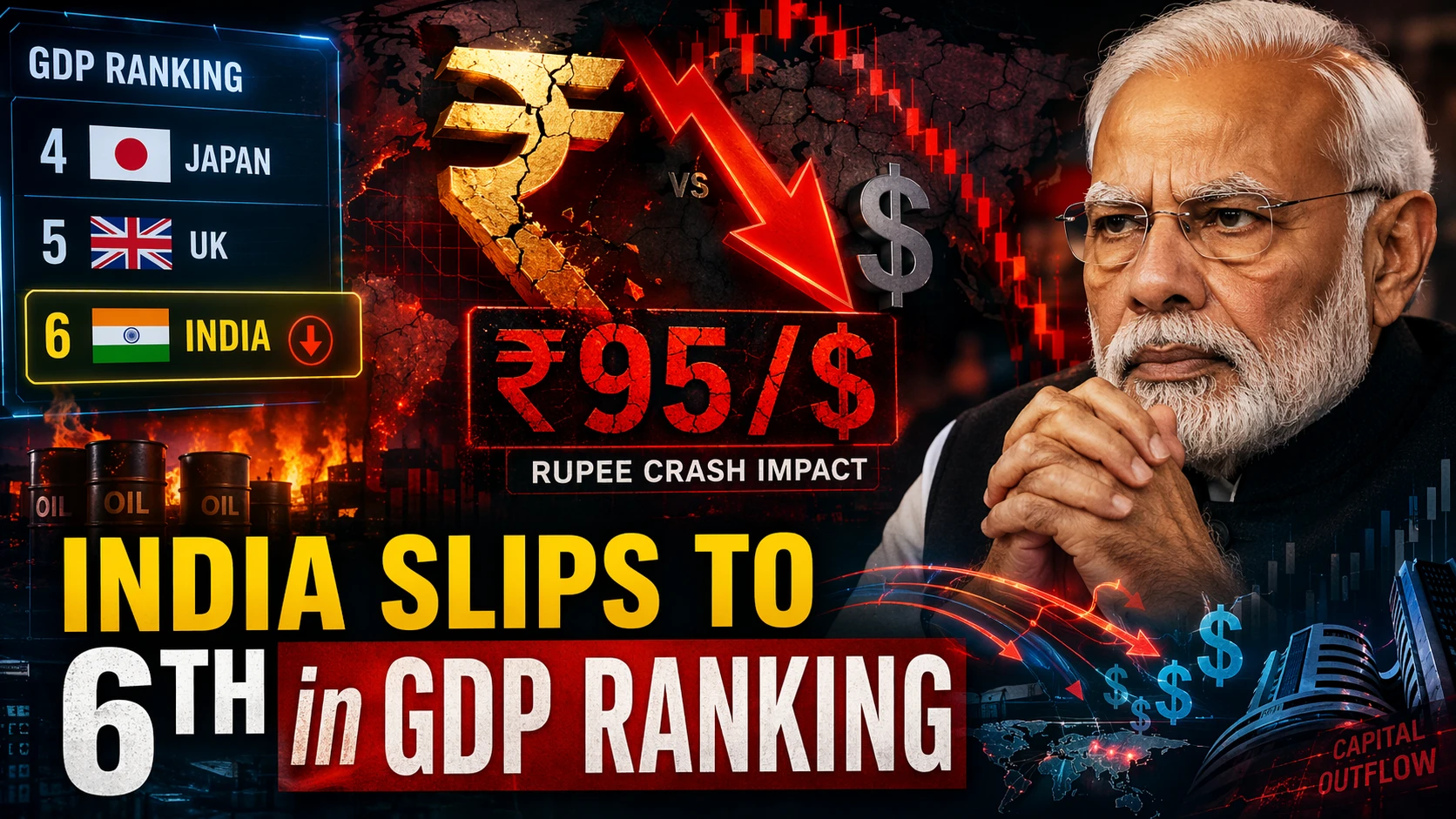
The headline is clear: India 6th largest economy IMF 2026.
According to the International Monetary Fund, India has slipped from fourth to sixth place in global nominal GDP rankings—now trailing the Japan and the United Kingdom.
But here’s what that actually means.
India’s economy has not collapsed.
In fact, it continues to grow rapidly.
So why did the ranking fall?
This is where things shift.
Sources: IMF, The New Indian Express, News18
The “Nominal GDP Trap” Explained
This situation reflects what can be called a nominal GDP trap.
Global rankings are calculated in US dollars—not in local currency.
That means:
Even if India produces more goods and services domestically,
a weaker currency reduces its value when converted into dollars.
So the economy grows…
But appears smaller globally.
That’s not a productivity issue.
That’s a valuation issue.
And that distinction matters.
Rupee Depreciation: The Core Trigger
At the center of this shift is the falling Indian rupee.
The currency has weakened sharply—from around ₹82–83 per dollar to a critical ₹93–₹95 per dollar range.
This range is not just a number—it has become a technical anchor for understanding India’s current global ranking shift.
Here’s what that means.
Global GDP is calculated in US dollars.
So when the rupee weakens, India’s entire economic output—no matter how strong domestically—translates into fewer dollars on paper.
That is exactly what happened.
India kept growing.
But its global valuation fell.
This is the paradox.
India remains the fastest-growing major economy—yet its ranking is slipping.
That contrast is not accidental.
It is structural.
Sources: The New Indian Express, Business World
West Asia Crisis and Oil Shock
Now look at the external trigger.
Geopolitical tensions in West Asia—especially involving Iran, Israel, and the United States—have disrupted energy markets.
This has direct consequences for India.
India imports a large portion of its crude oil.
As oil prices rise:
- Import costs increase
- Trade deficit widens
- Currency weakens further
At the same time, instability in countries like Saudi Arabia and the United Arab Emirates has impacted remittances.
Many Indian workers have returned.
Cash inflows have slowed.
That’s another pressure point.
This is not just economics.
It’s geopolitics feeding into economics.
Sources: The Economic Times
Current Account Deficit: The 2% Warning Signal
Now comes the more serious concern.
India’s current account deficit (CAD) is projected to rise toward 2% of GDP.
That number matters.
Because in macroeconomic terms, 2% is a big negative threshold.
It signals:
Rising import pressure
Increasing dependence on foreign capital
Sustained downward pressure on the currency
And once CAD expands:
More dollars are needed →
Rupee weakens further →
GDP ranking drops again
This becomes a cycle.
A dangerous one.
Sources: The Hindu Business Line
The Real Structural Problem
So the issue is not growth.
The issue is translation.
India is producing more.
But earning less in dollar terms.
That gap is what is pushing the country down from 4th → 5th → now 6th position.
And unless:
The rupee stabilizes
CAD is controlled below critical levels
Export strength improves
This pattern may continue.
Stock Market Reaction and Investor Sentiment
Markets react quickly to perception shifts.
India’s stock market has already seen correction.
The Nifty 50 has declined by around 10%.
Why?
Because investors reassess positioning.
Earlier: investing in the world’s 4th largest economy
Now: investing in the 6th
That psychological shift affects capital flows.
And capital flows affect markets.
This was not random volatility.
This was recalibration.
Sources: Moneycontrol
Global Context: Nominal vs PPP Reality
There’s another layer often overlooked.
India may be 6th in nominal GDP…
But it remains among the top economies in purchasing power terms.
This creates a dual reality:
- Nominal GDP → global influence, trade power
- PPP GDP → domestic strength, consumption
So while rankings fluctuate, underlying economic activity remains strong.
Still, global perception is shaped by nominal rankings.
And perception drives investment.
Can India Recover Its Ranking?
Yes—but not automatically.
India’s path forward depends on three strategic corrections:
1. Stabilizing the Rupee
Currency volatility must be controlled.
2. Reducing Import Dependence
Especially in energy.
3. Expanding Exports
Without export growth, CAD pressure will persist.
There is also a geopolitical dimension.
Ongoing conflicts—especially around energy routes—must stabilize.
Because prolonged instability directly impacts India’s economy.
This is where policy becomes decisive.
Final Analysis
India’s fall to sixth place is not a decline in capability.
It is a reflection of currency pressure and global volatility.
Growth remains strong.
But growth alone is not enough in a dollar-dominated system.
The real challenge now is structural.
Stabilize the rupee.
Control the deficit.
Navigate geopolitics effectively.
That will determine whether India reclaims its trajectory toward becoming the third-largest economy.
And the bigger question is:
Will India act fast enough to convert strong growth into global economic power—or will currency pressure continue to distort its rise?
FAQs
Why is India now the 6th largest economy?
India’s ranking dropped mainly due to rupee depreciation, which reduced its GDP value in dollar terms, allowing the UK and Japan to move ahead.
Is India still the fastest-growing economy?
Yes. India remains one of the fastest-growing major economies despite the ranking drop.
How does currency affect GDP ranking?
GDP rankings are calculated in US dollars. A weaker currency reduces the converted value of a country’s economy, lowering its rank.
What is current account deficit and why it matters?
It is the gap between imports and exports. A higher deficit weakens the currency and increases economic vulnerability.
Will India become the 3rd largest economy?
Projections suggest it could happen by 2027–28, but it depends on currency stability and external conditions.
What Do You Think?
India’s growth story is still strong—but global rankings are telling a different narrative.
Is this just a temporary currency-driven distortion…
Or a warning sign that deeper structural changes are urgently needed?
Do you think India can realistically reclaim its position and become the 3rd largest economy by 2027–28?
Explore more about Economy & Trade and Indian Affairs.