Table of Contents
Why the Norway Cartoon Triggered Outrage in India
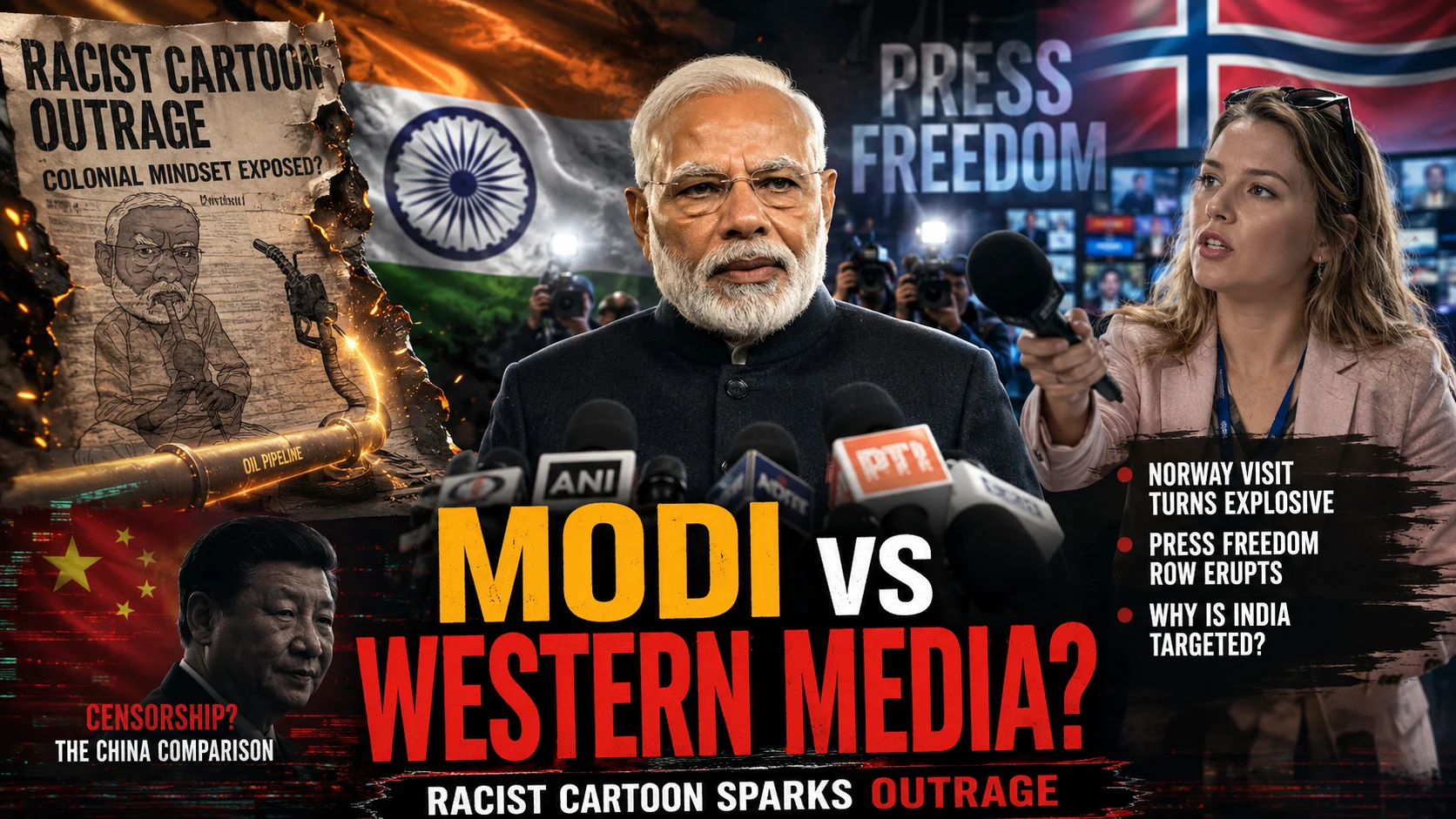
The Modi Norway visit press freedom row became controversial after a Norwegian newspaper portrayed Prime Minister Narendra Modi as a snake charmer and described him as “a snaky and slightly enigmatic man.” The article claimed Modi gets work done in a secretive and unfair manner. In the cartoon, instead of a snake coming out of the basket, a petrol pipe was shown emerging from it.
Norway’s largest newspaper posts an cartoon of PM Modi as a snake charmer during his Oslo visit
— Shashank Mattoo (@MattooShashank) May 19, 2026
“A clever and slightly annoying man,” reads the headline pic.twitter.com/4YfCHzRfiX
The “snake charmer” image has repeatedly been used whenever Western media wants to portray India as backward. Many Indians living in Delhi, Mumbai, or other large cities may never even have seen a snake charmer in real life, yet the image continues appearing in foreign publications whenever India is discussed negatively.
The article also claimed that PM Modi stays connected with people through social media and other methods, and that this is how India exercises its power internationally. But for many Indians online, the bigger issue was not just satire. They believed the portrayal itself was racist. The controversy then moved beyond Norway and became part of a larger argument about how India is treated globally.
Sources: India TV, India Today, Aftenposten
The Snake Charmer Image Was Meant to Send a Message
India is often treated like a “soft state” internationally. Even neighboring countries have no fear of India, which is why these kinds of portrayals continue appearing openly in foreign media.
The comparison with China appeared repeatedly throughout the controversy. If a racist cartoon like this had been made about Xi Jinping, many international journalists would immediately begin defending China. Several journalists in different countries are seen as working on China’s behalf to a large extent and helping protect China’s image globally.
One example came from Taiwan, where a journalist was allegedly jailed for taking bribes from China. He reportedly bribed military personnel to obtain secret information and then passed that information to China. The same journalist regularly published pro-China reports and eventually “completely sold out to China.” Taiwan later banned Chinese media reports and removed reporters connected to “United Front activities.”
The message was direct: China aggressively protects its image, while India allows itself to be openly mocked. The comparison only became sharper from there.
Sources: AP News, Business Standard
Why Many Indians Saw This as an Attack on India Itself
Western media continues portraying India as backward no matter how much progress the country makes. Several examples reinforced this frustration.
One example involved a 2015 cartoon showing Indians receiving solar panels from the United Nations and supposedly eating them because they did not understand the technology. Today, India is among the leading countries in solar energy, yet the stereotype remained unchanged.
Another example came from the Paris Climate Summit period, where India was portrayed as an elephant and described as the obstacle to climate negotiations.
.@nytimes affronts India again, this time with a cartoon on climate change https://t.co/0xelmjNzCT pic.twitter.com/RDtwUbUVrz
— The Times Of India (@timesofindia) December 10, 2015
After ISRO’s Mars mission, Indians were shown arriving outside an elite European scientific club while sophisticated Europeans sat inside.
New York Times apologises for Mars mission cartoonhttp://t.co/0OZYKRWBH9 pic.twitter.com/y2baxkVbyC
— IndiaToday (@IndiaToday) October 6, 2014
The frustration behind these reactions was simple: whenever India succeeds, parts of the Western media still return to colonial-style stereotypes. And until India takes what many see as a stronger stance internationally, these portrayals are expected to continue.
But the debate became even more intense once China’s media influence entered the discussion fully.
Sources: The Guardian, The Times of India, India Today
Why China Was Brought Into the Debate Again and Again
China has influenced global media so strongly that almost nobody targets Xi Jinping the same way Modi was targeted in Norway. One example often mentioned is the Winnie-the-Pooh meme associated with Xi Jinping. China banned it everywhere, and foreign media outlets largely stopped publishing it.
Even searching Google for Xi Jinping cartoons rarely produces openly mocking images.
Another striking example came from a Korean newspaper cartoon about Donald Trump. Trump was shown in tattered clothes and on fire, with missiles in the background labeled “Made in China.” Meanwhile, Xi Jinping appeared calm and perfect while shaking hands with Trump. This was presented as the difference between a “hard state” and a “soft state.”
Mein Cartoon heute in The Brooklyn Daily Eagle pic.twitter.com/vWm0sGNefC
— Marian Kamensky (@MarianKamensky1) May 12, 2026
The argument throughout the controversy was blunt. China has built fear internationally, while India still allows Western media to define its image. That debate finally exploded during the press interaction in Norway itself.
Sources: The Guardian, The Korea Times
The Journalist Question That Turned the Visit Explosive
The second major controversy began when Norwegian journalist Helle Lyng asked Prime Minister Modi why India was not taking questions from “the freest press in the world.” She referred to India being ranked 157th in the World Press Freedom Index and questioned why there was no Q&A session during the event.
Primeminister of India, Narendra Modi, would not take my question, I was not expecting him to.
— Helle Lyng (@HelleLyngSvends) May 18, 2026
Norway has the number one spot on the World Press Freedom Index, India is at 157th, competing with Palestine, Emirates & Cuba.
It is our job to question the powers we cooperate… pic.twitter.com/vZHYZnAvev
No question-and-answer session had actually been planned for the program, and no other journalists were asking questions there. But the exchange quickly went viral online.
Attention then shifted toward the journalist’s previous writings. Many of her articles criticized Donald Trump, praised Xi Jinping, described China as a superpower, and criticized Elon Musk’s Tesla. That immediately raised suspicions among many people following the controversy.
Another major twist came when her Facebook and Instagram accounts were suspended. She publicly stated that people could no longer reach her on those platforms. Questions immediately followed about what exactly had happened and whether further investigation would reveal more details later.
Throughout all day I have struggled to log onto my Instagram account. Now I have been suspended. It is a small prize to pay for press freedom, but I’ve never experienced it before. pic.twitter.com/XCitS65Rlg
— Helle Lyng (@HelleLyngSvends) May 19, 2026
At the same time, another video surfaced where Norway’s Prime Minister was seen telling journalists to respect Indian democracy. That added another layer to an already explosive controversy.
Sources: India Today, The Indian Express
Why Norway Became the Most Controversial Stop of Modi’s Tour
Prime Minister Modi’s Norway visit became the most controversial stop of his five-country tour covering the UAE, the Netherlands, Sweden, Norway, and Italy. Norway combined multiple controversies together at once: racist cartoons, press freedom questions, China comparisons, and debates about India’s global image.
India continues being portrayed by sections of Western media through old stereotypes despite major progress in areas like space technology and solar energy. At the same time, China is seen as defending its image far more aggressively on the global stage.
The discussion eventually shifted toward Italy, which was viewed as the most economically important country of the entire tour. Important developments regarding the economy were expected from that visit because Italy had the strongest economy among the countries included in the diplomatic trip.
What began with one cartoon and one journalist’s question eventually turned into a much larger debate about how India believes it is viewed internationally.
FAQs
Why did the Modi Norway visit press freedom row become so controversial?
The controversy combined several issues together at once: a racist cartoon, questions about India’s press freedom ranking, accusations of Western media bias, and repeated comparisons with China. Many Indians believed the Norway incidents reflected deeper stereotypes about India.
What was controversial about the snake charmer cartoon?
The cartoon portrayed Prime Minister Modi as a snake charmer while describing him as “snaky and slightly enigmatic.” The “snake charmer” image has frequently been used to portray India as backward or uncivilized.
Why was China repeatedly mentioned in the debate?
China was repeatedly discussed because many people argued that international media avoids mocking Xi Jinping in the same way foreign publications target India. Several examples involving Taiwan, Winnie-the-Pooh censorship, and international reporting were used to support that argument.
What happened with journalist Helle Lyng?
Helle Lyng questioned PM Modi about why India was not taking questions from “the freest press in the world.” She referred to India being ranked 157th in the World Press Freedom Index and questioned why there was no Q&A session during the Norway event. Later, her Facebook and Instagram accounts were suspended, adding another controversy to the situation.
Why was the Italy visit considered important?
Italy was viewed as the most economically important country of the five-nation tour. Important economic developments were expected from that visit.
Closing Question
If India continues becoming stronger economically and technologically, will Western media stop using old stereotypes like the “snake charmer” image — or will India eventually respond more aggressively the way China already does?
Share Your Views in the Comments below.
Explore more about Indian Affairs.
Marco Rubio India Visit ‘Stupid People’ Comment Decoded